CSE2137 - Object Oriented Programming
Inheritance, Interfaces, and OOP Design
Term 151
- Q2(d) [2]: What is encapsulation?
- Q3(c) [3]: Does Java support multiple inheritances where each class is able to extend multiple classes?
- Q3(d) [2]: Distinguish between an interface and an abstract class with necessary example.
- Q3(e) [2]: What do you mean by garbage collection?
- Q5(b) [6]: Describe abstract class called "shape" which has three subclasses as "Triangle", "Rectangle" and "Circle". Define one method
area()in the abstract class and override thisarea()in these three subclasses to calculate for specific object i.e.area()of Triangle subclass should calculate area of triangle etc. Same for Rectangle and Circle. - Q5(c) [4]: Discuss public, private, protected and default access modifier with example.
Term 161
- Q3(c) [3]: What are abstract methods? Describe the circumstances in which an abstract method would be appropriate.
- Q4(c) [4]: Write a Java program for the following hierarchical inheritance block diagram.
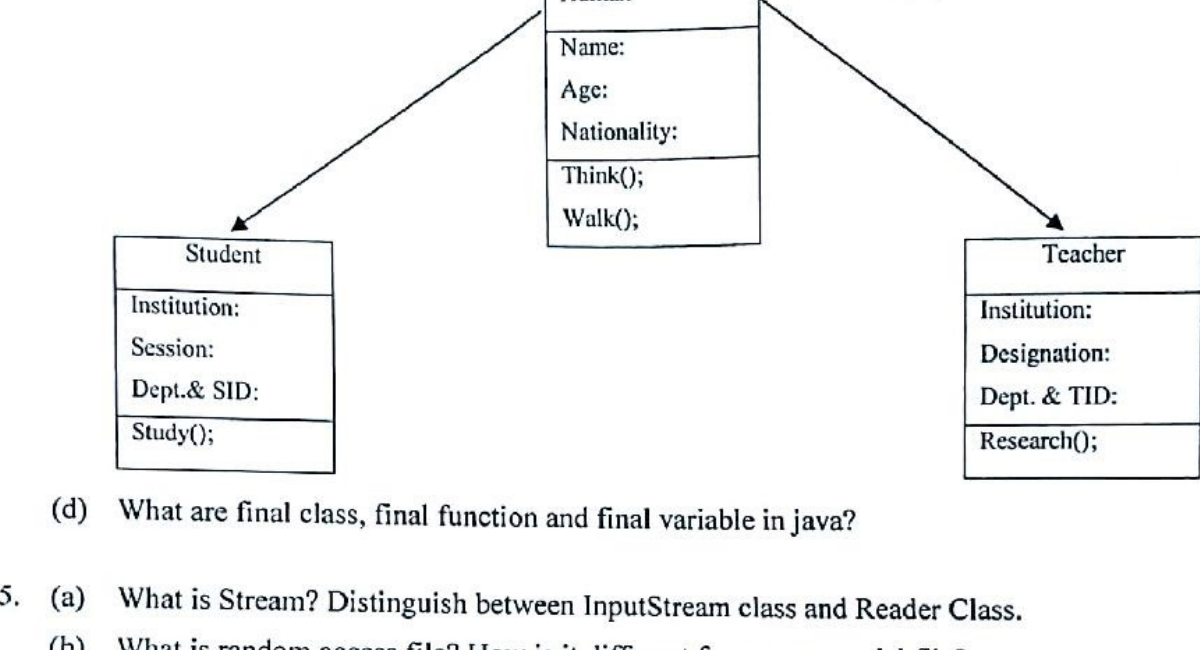
- Q6(c) [4]: Discuss public, private, protected and default access modifier with example.
Term 171
- Q1(b) [6]: Inheritance, Encapsulation and Polymorphism are three key attributes of Object Oriented Programming (OOP). Discuss these attributes in your own words. Include benefits of these attributes in your answer.
- Q3(a) [5]: Abstract classes and interfaces are two very important items we use in developing programs in OOP. What are they and what benefits do they provide us?
- Q3(c) [1+3]: What is aggregation in Java? Why and when should we use aggregation?
- Q5(b) [1+3]: What are the advantages of Java package? Explain the following four different types of java access modifier: (i) private, (ii) default, (iii) protected, (iv) public.
- Q6(c) [3]: What is the purpose of garbage collection in Java and when is it used?
Term 181
- Q1(c) [6]: Explain inheritance, encapsulation and polymorphism with examples.
- Q3(a) [4]: Explain what is meant by an 'abstract' class and what circumstance necessitates a class being abstract.
- Q3(b) [6]: Write the codes for implementations of the Employee and Person classes.
- Q5(a) [3+2+1]: What are Abstract classes and Interfaces? What benefits do they provide? Show how to declare abstract classes and interfaces in java.
Term 201
- Q2(a) [4]: Abstract classes and interfaces are two very important items we use in developing programs in OOP. What are they and what benefits do they provide?
- Q2(b) [2+2]: Can we achieve multiple inheritance by using interface? Explain with example. What is the difference between multiple and multilevel inheritance?
- Q3(a) [1+1]: What is inheritance in OOP? Does Java support multiple inheritances?
- Q3(b) [2+2]: What are the main features of OOPs? Write a Java program for the following hierarchical inheritance block diagram.
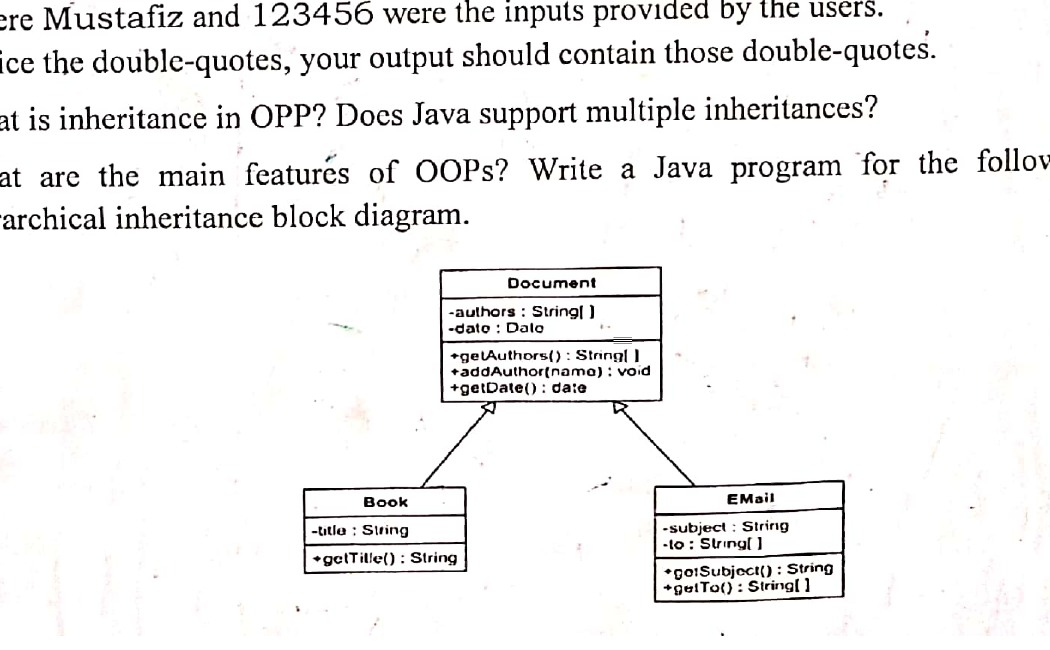
- Q4(b) [4]: Why do you use Upcasting and Downcasting in Java? Explain with examples.
Term 211
- Q1(b) [6]: Inheritance, encapsulation and polymorphism are three attributes of Object Oriented Programming (OOP). Discuss these attributes in your own words.
- Q3(a) [2+3]: How to declare a Package in Java? What are the advantages of Packages in Java?
- Q4(b) [2+3]: Why is Multiple Inheritance not supported in Java? How Interface is helpful to resolve this matter?
- Q4(c) [4]: Why do use upcasting and downcasting in Java? Explain with examples.