MAT2131 — Question Analysis
Estimated Exam Suggestion
Important: This is an evidence-based suggestion prepared from the supplied question papers for Terms 161, 171, 181, 191, 201, 211. It is not a guaranteed question paper.
How This Suggestion Was Prepared
- Every topic was counted by the number of distinct terms in which it appeared.
- A topic was counted only once in one term, even when several sub-questions from that term covered it.
- The core set prioritizes repeated topics while maintaining coverage across the handbook chapters.
- Every selected block is an intact question number from a supplied past paper.
- Original wording, spelling, grammar, numbering, marks, equations, code, tables and supplied figures are retained.
- Original figures are embedded directly in this Markdown file, so no separate image folder is required.
Quick Frequency Graph
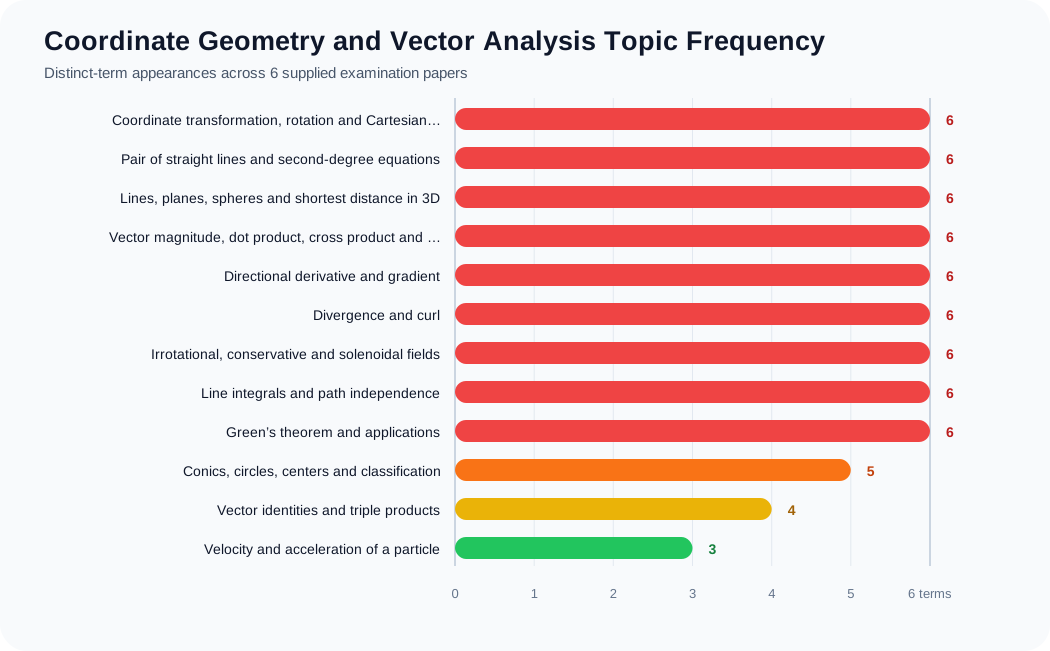
Priority Summary
| Priority | Topics |
|---|---|
| Very high | Coordinate transformation, rotation and Cartesian-polar relation; Pair of straight lines and second-degree equations; Lines, planes, spheres and shortest distance in 3D; Vector magnitude, dot product, cross product and projection; Directional derivative and gradient; Divergence and curl; Irrotational, conservative and solenoidal fields; Line integrals and path independence; Green’s theorem and applications |
| High | Conics, circles, centers and classification |
| Strong | Vector identities and triple products |
| Medium | Velocity and acceleration of a particle; Cylindrical, spherical and curvilinear coordinates; Polar equations of circles and conics; Gauss/Stokes theorem and volume integrals |
Core Estimated Question Set
Revise these seven original past-paper blocks first.
Core Question 1 — Cartesian-Polar Relation, Rotation of Axes and Pair of Lines
Original source: Term 211, Question 1
-
Q1(a) [6]: Find the relation between Cartesian coordinates and polar coordinates. Transform to polar coordinates the equation \(x^3=y^2(2a-x)\).
-
Q1(b) [5]: Determine the equation of the parabola \(x^2-2xy+y^2+2x-4y+3=0\) after rotating of axes through \(45^\circ\).
-
Q1(c) [3]: Prove that a homogeneous quadratic equation \(ax^2+2hxy+by^2=0\) always represents a pair of straight lines which passing through the origin.
Core Question 2 — Angle Bisectors, Equidistant Lines and Shortest Distance
Original source: Term 201, Question 2
-
Q2(a) [3]: If the pair of straight lines \(x^2-2axy-y^2=0\) and \(x^2-2bxy-y^2=0\) be such that each pair bisects the angle between the other pair, prove that \(ab=-1\).
-
Q2(b) [5]: Prove that the straight lines represented by the equation \(ax^2+2hxy+by^2+2gx+2fy+c=0\) will be equidistance from the origin, if \(f^4-g^4=c(bf^2-ag^2)\).
-
Q2(c) [6]: Find the length of the shortest distance between the lines \(\frac{x-1}{2}=\frac{y-2}{3}=\frac{z-3}{4}\) and \(\frac{x-2}{3}=\frac{y-3}{4}=\frac{z-4}{5}\). State whether the lines are coplanar or not.
Core Question 3 — Direction Cosines, Shortest Distance and Angle Between Line and Plane
Original source: Term 191, Question 5
-
Q5(a) [3]: Define direction cosines and direction ratios of a line.
-
Q5(b) [6]: Find the magnitude and the equation of shortest distance between the lines \(\frac{x-1}{2}=\frac{y-1}{3}=\frac{z-4}{4}\) and \(\frac{x-2}{2}=\frac{y-4}{4}=\frac{z-5}{5}\).
-
Q5(c) [5]: Determine the angle between the line \(\frac{x-3}{6}=\frac{y-2}{3}=\frac{z+1}{-2}\) and the plane \(2x+y+2z+5=0\).
Core Question 4 — Position Vectors, Projection, Direction Angles and Triple Product
Original source: Term 201, Question 4
-
Q4(a) [3]: The position vectors of points P and Q are given by \(\vec r_1=2\hat i+3\hat j-\hat k\), \(\vec r_2=4\hat i-3\hat j+2\hat k\). Determine \(\overrightarrow{PQ}\) in terms of \(\hat i,\hat j,\hat k\) and finds its magnitude.
-
Q4(b) [3]: Find the projection of the vector \(4\hat i-3\hat j+\hat k\) on the line passing through the points \((2,3,-1)\), \((-2,-4,3)\).
-
Q4(c) [4]: Find the angle which the vector \(\vec A=3\hat i-6\hat j+2\hat k\) makes with the coordinate axes.
-
Q4(d) [4]: Prove that \(\vec A\cdot(\vec B\times\vec C)=\vec B\cdot(\vec C\times\vec A)=\vec C\cdot(\vec A\times\vec B)\).
Core Question 5 — Directional Derivative, Irrotational/Solenoidal Fields and Curl
Original source: Term 191, Question 3
-
Q3(a) [4]: Find the directional derivative of \(\phi=x^2yz^2+4y^2z\) at \((-1,-2,-1)\) in the direction \(5\hat i-2\hat j-3\hat k\).
-
Q3(b) [5]: Check whether \(\vec F=(2xy+z^3)\hat i+x^2\hat j+3xz^2\hat k\) is irrotational or solenoidal.
-
Q3(c) [5]: Suppose \(\vec v=\vec w\times\vec r\), show that \(\vec w=\frac12\operatorname{curl}\vec v\), where \(\vec w\) is a constant vector.
Core Question 6 — Curl, Solenoidal Field and Angle Between Surfaces
Original source: Term 201, Question 6
-
Q6(a) [5]: What is curl of a vector? If \(\vec V=\vec\omega\times\vec r\), prove that \(\vec\omega=\frac12\operatorname{curl}\vec V\), where \(\vec\omega\) is a constant vector.
-
Q6(b) [5]: When a vector is called solenoidal? Show that \(\vec A=(2x^2+8xy^2z)\hat i+(3x^3y-3xy)\hat j-(4y^2z^2+2x^3z)\hat k\) is not solenoidal but \(\vec B=xyz^2\vec A\) is solenoidal.
-
Q6(c) [4]: Find the angle between the surfaces \(z=x^2+y^2\) and \(z=2xy+e^x\) at the point \((0,1,2)\).
Core Question 7 — Line, Surface and Volume Integrals with Green’s Theorem
Original source: Term 191, Question 7
-
Q7(a) [3]: Give the idea of line, surface and volume integral.
-
Q7(b) [6]: Compute \(\oint_C x^2y\,dx+y^3\,dy\) by Green's theorem where C is the closed path formed by \(y=x\) and \(y^3=x^2\) from \((0,0)\) to \((1,1)\).
-
Q7(c) [5]: Evaluate \(\iiint\nabla\cdot\vec F\,dv\) where \(\vec F=xy\hat i+z^2\hat j+2xz\hat k\) bounded by the region \(x=0\), \(y=0\), \(z=0\) and the plane \(x+y+z=1\).
High-Value Backup Question Set
Revise these after completing the seven core blocks.
Backup Question 1 — Plane, Translation of Axes and Pair of Straight Lines
Original source: Term 161, Question 1
-
Q1(a) [4]: Find the equation of the plane through the points \((1,-2,2)\) and \((-3,1,2)\) and perpendicular to plane \(2x+y-z+6=0\).
-
Q1(b) [5]: Remove first degree terms from the equation \(3x^2+4y^2-12x+4y+13=0\).
-
Q1(c) [5]: Find the condition that the general equation \(ax^2+2hxy+by^2+2gx+2fy+c=0\) may represents a pair of straight lines.
Backup Question 2 — Shortest Distance and Equation of a Plane
Original source: Term 161, Question 2
-
Q2(a) [8]: Find the length and equation of shortest distance (SD) between the lines \(\frac{x-1}{4}=\frac{y-2}{3}=\frac{z-1}{-5}\) and \(\frac{x+1}{2}=\frac{y-3}{3}=\frac{z-4}{-4}\).
-
Q2(b) [6]: Obtain the equation of the plane which is perpendicular to the plane \(x+2y-3z+1=0\) and which contains the line of intersection of the planes \(3x+y+z-5=0\) and \(2x-3y+z+11=0\).
Backup Question 3 — Green, Stokes and Gauss Theorems with Integrals
Original source: Term 181, Question 7
-
Q7(a): State Green's theorem, Stokes theorem and the Gauss divergence theorem.
-
Q7(b): Evaluate the volume integral \(\iiint\operatorname{div}\vec F\,dv\) for the vector field \(\vec F=(2xy+z)\hat i+y^3\hat j-(e^x+3y)\hat k\) taken over the region bounded by \(2x+2y+z=6\), \(x=0\), \(y=0\), \(z=0\).
-
Q7(c): If \(\vec F=(xy-6x^2)\hat i+(2x-4x)\hat j\), evaluate \(\int_C\vec F\cdot d\vec r\) where C is the curve in the xy plane \(y=x^3\), from \((1,1)\) to \((2,8)\).
-
Q7(d): Write down curvilinear coordinates in polar, cylindrical and spherical coordinates.
Backup Question 4 — Green’s Theorem and Conservative Force Field
Original source: Term 211, Question 7
-
Q7(a): State and prove Green's theorem.
-
Q7(b): Verify Green's theorem in the plane for \(\oint_C(xy+y^2)dx+x^2dy\), where C is the closed curve of the region bounded by \(y=x\) and \(y=x^2\).
-
Q7(c): Show that \(\vec F=(2xy+z^3)\hat i+x^2\hat j+3xz^2\hat k\) is a conservative force field; also find the total work done in moving an object in this field from \((1,-2,1)\) to \((3,1,4)\).
Backup Question 5 — Green’s Theorem and Line Integrals
Original source: Term 201, Question 7
-
Q7(a): State and prove Green's theorem in the plane.
-
Q7(b) [4]: If \(\phi=2xyz^2\), \(\vec F=xy\hat i-z\hat j+x^2\hat k\) and C is the curve \(x=t^2\), \(y=2t\), \(z=t^3\) from \(t=0\) to \(t=1\), evaluate the line integrals (i) \(\int_C\phi\,d\vec r\); (ii) \(\int_C\vec F\times d\vec r\).
-
Q7(c): Verify Green's theorem in the plane for \(\oint_C(3x^2-8y^2)dx+(4y-6xy)dy\), where C is the boundary of the region defined by \(y=\sqrt{x}\) and \(y=x^2\).
Final Revision Checklist
- Complete all seven core question blocks.
- Complete all five backup blocks if time permits.
- Practise every embedded graph, tree, class diagram, equation, algorithm and code fragment exactly as shown.
- Use the separate topic-frequency file to cover any remaining syllabus area.