Estimated Exam Suggestion
Important: This is an evidence-based suggestion prepared from the supplied question papers for Terms 151, 161, 171, 181, 191, 201 and 211. It is not a guaranteed question paper.
How This Suggestion Was Prepared
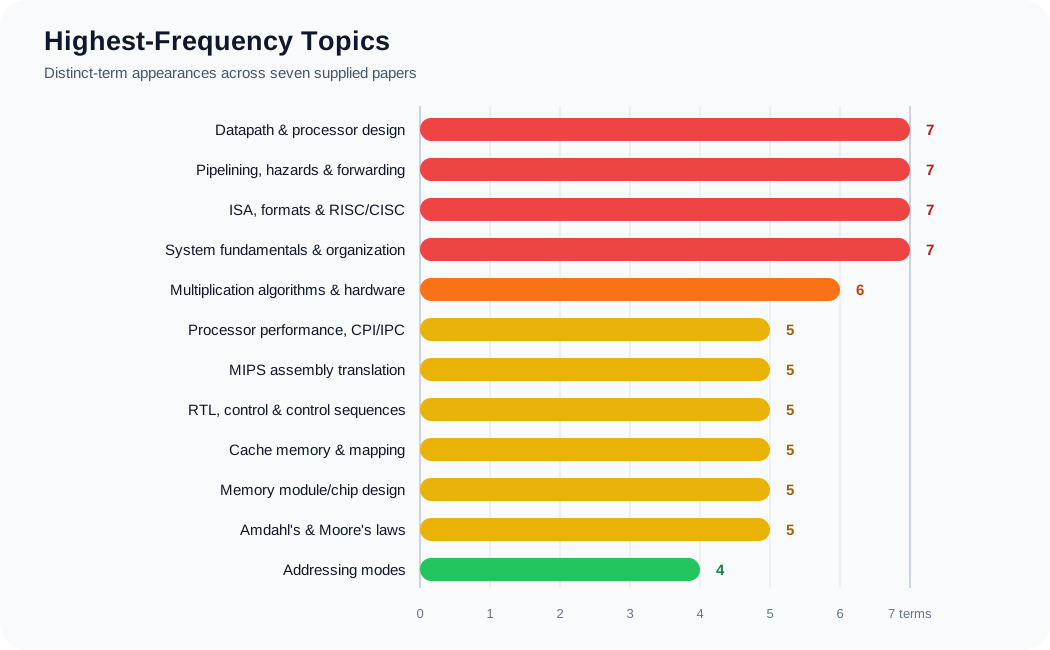
- Every topic was counted by the number of distinct terms in which it appeared.
- A topic was counted only once in one term, even when several sub-questions from that term covered it.
- The suggestion gives priority to repeated topics while maintaining balanced coverage of the five handbook chapters.
- Each selected block is an intact 14-mark question from a supplied past paper.
- Original wording, spelling, grammar, numbering, marks, equations, code and tables are retained.
- Questions that ask for a diagram or block diagram are kept exactly as printed. No substitute diagram has been inserted because the original question prompt did not supply one.
Quick Frequency Graph
Priority Summary
| Priority | Topics |
|---|---|
| Very high | Datapath and processor design; pipelining and hazards; ISA/MIPS formats and RISC/CISC; computer-system fundamentals; multiplication |
| High | Processor performance and CPI/IPC; MIPS code translation; RTL/control; cache mapping; memory-module design; Amdahl's and Moore's laws |
| Strong | Addressing modes; instruction cycle and execution steps |
| Backup | Virtual memory/TLB; DMA/interrupt; IEEE 754; parallel architecture; advanced ILP |
Core Estimated Question Set
The following seven blocks provide a complete 7 × 14 = 98 marks past-paper-based suggestion.
Core Question 1 — Processor Performance and Amdahl's Law
Original source: Term 161, Question 5 — 14 marks
- Q5(a) [5]: How the performance of a computer is measured? Explain with example.
- Q5(b) [6]: Consider three different processors P1, P2, and P3 executing the same instruction set. P1 has a 3 GHz clock rate and a CPI of 1.5. P2 has a 2.5 GHz clock rate and a CPI of 1.0. P3 has a 4.0 GHz clock rate and has a CPI of 2.2.
- Which processor has the highest performance expressed in instructions per second?
- If the processors each execute a program in 10 seconds, find the number of cycles and the number of instructions.
- We are trying to reduce the execution time by 30% but this leads to an increase of 20% in the CPI. What clock rate should we have to get this time reduction?
- Q5(c) [3]: Explain Amdahl's Law.
Core Question 2 — Computer Design, MIPS Formats and Assembly
Original source: Term 171, Question 3 — 14 marks
- Q3(a) [4]: Briefly discuss about four design principle of a computer.
- Q3(b) [6]: Explain different instruction format in MIPS machine language.
- Q3(c) [4]: Write down the assembly code for the following code segment:
Core Question 3 — Datapath, Control Signals and Dynamic Scheduling
Original source: Term 211, Question 3 — 14 marks
- Q3(a) [5]: Explain with block diagram, the data path of a processor.
- Q3(b) [3]: What are the control signals for the data path?
- Q3(c) [6]: Briefly explain about dynamic scheduler with block diagram.
Core Question 4 — Pipelining, Dependency and Forwarding
Original source: Term 211, Question 4 — 14 marks
- Q4(a) [3]: Explain the pipelined operation in ideal case.
- Q4(b) [4]: What are the issues of pipelined operation?
- Q4(c) [3]: Explain with example the use of operand forwarding to resolve data dependency issue.
- Q4(d) [4]: Show the modification in data path to support data forwarding.
Core Question 5 — Binary Multiplier and Booth Algorithm
Original source: Term 211, Question 5 — 14 marks
- Q5(a) [6]: Design a 4-bit binary multiplier with details implementation.
- Q5(b) [8]: Briefly analysis the booth multiplication algorithm for the given input: \(16 \times -2\).
Core Question 6 — Memory-Module Design and Cache Mapping
Original source: Term 171, Question 7 — 14 marks
- Q7(a) [6]: Give a block diagram for a \(512k \times 32\) memory module using \(128k \times 8\).
- Q7(b) [3+5]: Why mapping function is needed when we use cache memory in the computer system? Explain three different mapping functions.
Core Question 7 — Memory Technology, Interrupt and DMA
Original source: Term 201, Question 4 — 14 marks
- Q4(a) [2+2]: Define memory latency and bandwidth. What is the special feature of DDR SDRAM?
- Q4(b) [4+2]: Explain interrupt with its hardware circuit diagram. Draw the block diagram of multiple priority interrupt unit.
- Q4(c) [4]: Explain Direct Memory Access (DMA) controller with necessity diagram.
High-Value Backup Question Set
These are full 14-mark blocks. Revise them after completing the seven core questions.
Backup Question 1 — ISA, Embedded Processors and Performance Law
Original source: Term 151, Question 1 — 14 marks
- Q1(a) [6]: What do you understand by Instruction Set Architecture (ISA)? Explain the seven dimension of ISA.
- Q1(b) [3]: Why embedded processor market is higher than the others?
- Q1(c) [3]: Explain the Amdahl's law. What is the significance of this law?
- Q1(d) [2]: List the registers of x86 microprocessor.
Backup Question 2 — MIPS Implementation, Assembly and Data Hazard
Original source: Term 151, Question 2 — 14 marks
- Q2(a) [5]: Explain the basic MIPS implementation of instruction set.
- Q2(b) [6]: Write down MIPS assembly code for following C code:
f = (g - h) + (i - j). - Q2(c) [3]: What is data hazard? How do you overcome it? What are its side effects?
Backup Question 3 — Benchmark Calculation and Virtual Memory
Original source: Term 191, Question 5 — 14 marks
- Q5(a) [8]: A benchmark program is run on a 40 MHz processor. The executed program consists of 100,000 instruction executions, with the following instruction mix and clock cycle count:
| Instruction Type | Instruction Count | Cycle per Instruction |
|---|---|---|
| Integer arithmetic | 45000 | 1 |
| Data transfer | 32000 | 2 |
| Floating point | 15000 | 2 |
| Control transfer | 8000 | 2 |
Determine the effective CPI, MIPS rate for this program.
- Q5(b) [6]: Explain page fault, address translation and page table.
Backup Question 4 — Hazard Removal, Branch Prediction and Fast Address Translation
Original source: Term 191, Question 6 — 14 marks
- Q6(a) [4]: How data and control hazard is removed? Explain.
- Q6(b) [4]: What is branch prediction? How branch target buffer can be used for branch prediction?
- Q6(c) [6]: Explain the proper techniques for fast address translation.
Backup Question 5 — Memory Hierarchy, Chip Organization and SRAM
Original source: Term 201, Question 3 — 14 marks
- Q3(a) [4]: Define memory hierarchy. As one goes down the hierarchy, what happens about (i) Cost per bit; (ii) Capacity; (iii) Access time; (iv) Frequency of access of the memory by the processor.
- Q3(b) [6]: Explain with diagram the organization of a \(1K \times 1\) memory chip.
- Q3(c) [4]: Describe the read and write operation from SRAM.
Final Revision Checklist
Must Revise First
- [ ] Single-cycle datapath and control
- [ ] Processor datapath and control signals
- [ ] Pipeline stages and ideal pipelining
- [ ] Structural, data and control hazards
- [ ] Operand forwarding and branch prediction
- [ ] ISA and MIPS instruction formats
- [ ] RISC and CISC
- [ ] MIPS assembly translation
- [ ] Binary multiplication and Booth multiplication
- [ ] CPI, IPC, execution time, MIPS and Amdahl's Law
- [ ] Cache mapping
- [ ] Memory-module design
Revise Next
- [ ] RTL and control sequences
- [ ] Addressing modes
- [ ] Instruction cycle and execution steps
- [ ] Virtual memory, page table, TLB and address translation
- [ ] Interrupt and DMA
- [ ] IEEE 754
- [ ] Computer classes, layers, functional units and bus structure
- [ ] Flynn's classification and parallel architecture
- [ ] Dynamic scheduling and multithreading
Suggested Practice Order
- Answer the seven core blocks under exam timing.
- Draw every requested datapath, pipeline, multiplier and memory diagram from memory.
- Solve the numerical performance and multiplication questions without notes.
- Complete the five backup blocks.
- Use the frequency table only for priority; do not omit the remaining syllabus.
Final Note
The strongest historical pattern is clear: datapath, pipelining, ISA/MIPS, system organization, multiplication, performance, cache and memory design deserve the greatest revision time. However, a lower-frequency topic may still appear, so this file should guide priority rather than replace complete syllabus preparation.