Linked List
Study Notes: Linked Lists (Section 5.2)
1. Definition & Structure
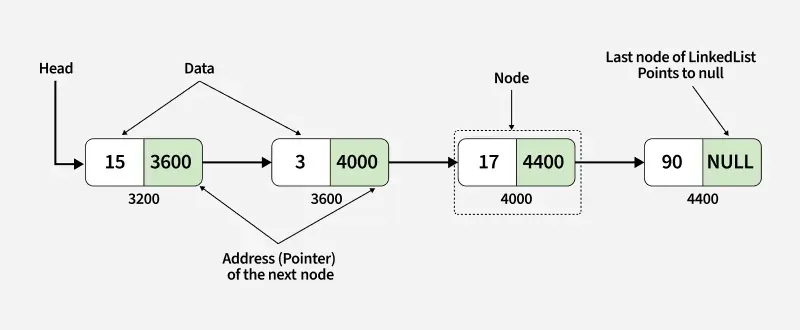
A Linked List (or One-Way List) is a linear collection of data elements called nodes. Unlike arrays, the linear order is not defined by physical memory location but by pointers.
Each node is physically divided into two distinct parts:
- Information Part: Stores the actual data or record (e.g., Name, Address, ID).
- Link Field (Nextpointer Field): Stores the memory address of the next node in the sequence.
2. Key Components
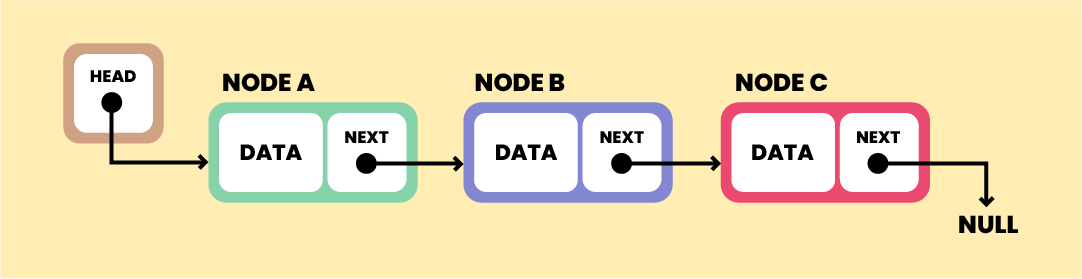
- START (or NAME): A special pointer variable that stores the address of the first node. This is the entry point of the list.
- Null Pointer: A special value (often denoted by X, 0, or a negative number) stored in the link field of the last node. It signals the end of the list.
- Empty List (Null List): A list with no nodes. In this case, the
STARTvariable itself contains the null pointer.
3. Traversal Mechanism
To access the data, we follow the pointer in START to reach the first node. We then use the Nextpointer of that node to find the second, continuing this chain until we encounter the null pointer.
Visual Representation Breakdown
- Nodes: Represented as boxes with two compartments.
- Arrows: Represent the address stored in the link field pointing to the next node.
- Terminal: The 'X' in the final node represents the end of the data chain.
Revision Summary (Exam Quick-View)
| Term | Definition |
|---|---|
| Node | The basic unit of a linked list containing data and a pointer. |
| Link Field | The part of the node that "points" to the next element. |
| START | The variable that holds the address of the first node. |
| Null Pointer | An invalid address (0 or -1) marking the end of the list. |
| Empty List | A list where START = NULL. |