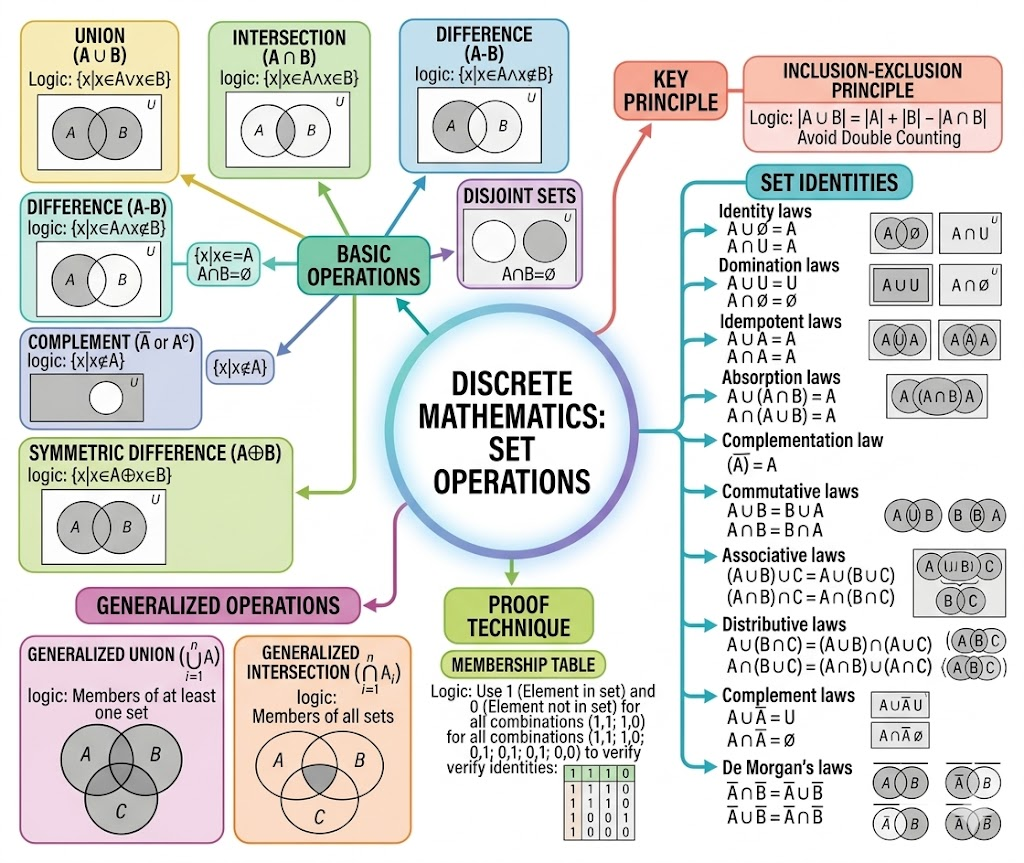
Discrete Mathematics: Complete Exam Notes with Bangla Meanings
1. Historical Notes (ঐতিহাসিক টীকা)
-
Georg Ferdinand Ludwig Philipp Cantor: Born March 3, 1845; Died January 6, 1918. He is the founder
(প্রতিষ্ঠাতা)of set theory. -
John Venn: Born August 4, 1834; Died April 4, 1923. He introduced
(প্রবর্তন করেন)Venn diagrams.
2. Core Definitions (মূল সংজ্ঞাসমূহ)
-
Set (সেট): An unordered
(ক্রমহীন/যার কোনো নির্দিষ্ট সাজানোর নিয়ম নেই)collection of objects, finite(সসীম)or infinite(অসীম), that all possess(অধিকারী হওয়া)the same property: membership(সদস্যপদ)of the set. -
Elements / Members (উপাদান/সদস্য): The objects in a set. The elements are said to belong to
(অন্তর্ভুক্ত হওয়া)that set, and a set is said to contain(ধারণ করা)its elements. -
Membership Notation (সদস্যতা প্রকাশের চিহ্ন):
-
\(a \in A\) denotes
(নির্দেশ করে)that \(a\) is an element of set \(A\). -
\(a \notin A\) denotes that \(a\) is not an element of set \(A\).
3. Methods of Describing Sets (সেট প্রকাশের পদ্ধতিসমূহ)
There are three standard ways to describe a set according to the slides:
A. Braces / Roster Method (দ্বিতীয় বন্ধনী বা তালিকা পদ্ধতি)
Listing all elements explicitly (স্পষ্টভাবে) between braces {}.
- Example: The set \(V\) of all vowels
(স্বরবর্ণ)in the English alphabet: \(V = \{a, e, i, o, u\}\).
B. Ellipses Notation (উপবৃত্ত বা ডট ডট চিহ্ন ...)
Used to describe a set without listing all members when the general pattern (সাধারণ ধারা) of the elements is obvious (স্পষ্ট/সহজেই বোঝা যায়).
-
Finite Example: Positive integers
(ধনাত্মক পূর্ণসংখ্যা)less than 100: \(C = \{1, 2, 3, \dots, 99\}\). -
Infinite Example 1: Natural numbers
(স্বাভাবিক সংখ্যা): \(\mathbb{N} = \{0, 1, 2, 3, \dots\}\). -
Infinite Example 2: Integers
(পূর্ণসংখ্যা): \(\mathbb{Z} = \{\dots, -2, -1, 0, 1, 2, \dots\}\).
C. Set-Builder Notation (সেট গঠন পদ্ধতি)
We characterize (বৈশিষ্ট্য নির্ধারণ করা) all those elements in the set by stating the property or properties they must have to be members.
- Example 1: The set \(O\) of all odd positive integers
(বিজোড় ধনাত্মক পূর্ণসংখ্যা)less than 10:
(Note: \(\land\) means 'and')
- Example 2: The set of rational numbers
(মূলদ সংখ্যা)\(\mathbb{Q}\):
4. Important Standard Sets (গুরুত্বপূর্ণ স্ট্যান্ডার্ড সেটসমূহ)
-
\(\mathbb{N} = \{0, 1, 2, 3, \dots\}\) : The set of Natural numbers. (Note: 0 is included here)
-
\(\mathbb{Z} = \{\dots, -2, -1, 0, 1, 2, \dots\}\) : The set of Integers.
-
\(\mathbb{Z}^+ = \{1, 2, 3, \dots\}\) : The set of Positive integers.
-
\(\mathbb{Q} = \{p/q \mid (p \in \mathbb{Z}) \land (q \in \mathbb{Z}) \land (q \neq 0)\}\) : The set of Rational numbers.
-
\(\mathbb{R}\) : The set of Real numbers
(বাস্তব সংখ্যা). -
\(\mathbb{C}\) : The set of Complex numbers
(জটিল সংখ্যা).
5. Set Equality and Special Sets (সেটের সমতা এবং বিশেষ সেট)
- Definition of Equality: Two sets are equal if and only if
(কেবল এবং কেবল যদি)they have the same elements. Order does not matter.
(Note: \(\forall\) means 'for all', \(\leftrightarrow\) means 'if and only if')
-
Example: The sets \(\{1, 3, 5\}\) and \(\{3, 5, 1\}\) are equal.
-
Empty Set / Null Set (ফাঁকা সেট): A special set that has no elements. It is denoted by
(চিহ্ন দ্বারা প্রকাশ করা)\(\emptyset\) or by \(\{\}\). -
Singleton (একপদী সেট): A set that contains exactly one element.
6. Subsets (উপসেট)
- Definition: Set \(A\) is said to be a subset of set \(B\), denoted by \(A \subseteq B\), if and only if every element of \(A\) is also an element of \(B[cite: 1]\).
(Note: \(\rightarrow\) means 'implies' or 'then')
- Proper Subset (প্রকৃত উপসেট): When we wish to emphasize
(জোর দেওয়া/বিশেষভাবে বোঝানো)that \(A\) is a subset of \(B\) but \(A \neq B\), we write \(A \subset B\) or \(A \subsetneq B\).
Two Subsets of a Non-Empty Set (দুটি অবশম্ভাবী উপসেট)
-
Theorem 1: The empty set is a subset of all the sets (\(\emptyset \subseteq S\), for any set \(S\)).
-
Theorem 2: Every set is a subset of itself (\(S \subseteq S\), for any set \(S\)).
7. Venn Diagrams (ভেন চিত্র)
-
Universal Set (সার্বিক সেট): The set \(U\) which contains all the objects under consideration
(বিবেচনাধীন). It is represented by a rectangle(আয়তক্ষেত্র). It varies(পরিবর্তন হয়)depending on which objects are of interest. -
Inside the rectangle, circles or other geometrical figures
(জ্যামিতিক চিত্র)represent sets. -
Sometimes points are used to represent particular
(নির্দিষ্ট)elements.
8. Cardinality and Power Set (কার্ডিনালিটি এবং পাওয়ার সেট)
-
Cardinality (সেটের উপাদান সংখ্যা): Let \(S\) be a set. If there are exactly \(n\) distinct
(স্বতন্ত্র/আলাদা আলাদা)elements in \(S\) where \(n\) is a non-negative integer(অ-ঋণাত্মক পূর্ণসংখ্যা), we say \(S\) is a finite set and \(n\) is the cardinality of \(S\). -
It is denoted by \(|S|\).
-
An infinite set is a set that is not finite.
-
The cardinality of the empty set is 0 (\(|\emptyset| = 0\)).
-
Power Set (শক্তি সেট): Given a set \(S\), the power set of \(S\) is the set of all the subsets of \(S\). It is denoted by \(\mathcal{P}(S)\).
-
Example: If \(S = \{0, 1, 2\}\), then \(\mathcal{P}(S) = \{\emptyset, \{0\}, \{1\}, \{2\}, \{0, 1\}, \{0, 2\}, \{1, 2\}, \{0, 1, 2\}\}\).
-
Formula: If \(|S| = n\), then \(|\mathcal{P}(S)| = 2^n\).
9. Ordered \(n\)-tuples and Cartesian Product (ক্রমিত n-জোড় এবং কার্তেসীয় গুণজ)
Ordered \(n\)-tuple (ক্রমিত n-জোড়)
-
The ordered \(n\)-tuple \((a_1, a_2, \dots, a_n)\) is the ordered collection
(ক্রম সাজানো সংগ্রহ)that has \(a_1\) as its first element, \(a_2\) as its second element, and \(a_n\) as its \(n\)-th element. -
Two \(n\)-tuples are equal if and only if each corresponding pair
(অনুরূপ জোড়া)of their elements is equal. -
We call 2-tuples couples or ordered pairs
(ক্রমজোড়).
Cartesian Product of Two Sets (\(A \times B\))
- The Cartesian product of \(A\) and \(B\), denoted by \(A \times B\), is the set of all ordered pairs \((a, b)\), where \(a \in A\) and \(b \in B\).
-
Example: If \(A = \{1, 2\}\) and \(B = \{a, b, c\}\), then \(A \times B = \{(1, a), (1, b), (1, c), (2, a), (2, b), (2, c)\}\).
-
Crucial Note: The Cartesian products \(A \times B\) and \(B \times A\) are, in general, not equal
(সাধারণত সমান হয় না).
Cartesian Product of \(n\) Sets (\(A_1 \times A_2 \times \dots \times A_n\))
- The set of ordered \(n\)-tuples \((a_1, a_2, \dots, a_n)\), where \(a_i\) belongs to \(A_i\) for \(i = 1, 2, \dots, n\).
- Some authors use the notation
(প্রতীক/চিহ্ন): \(\prod_{i=1}^{n} A_i\).
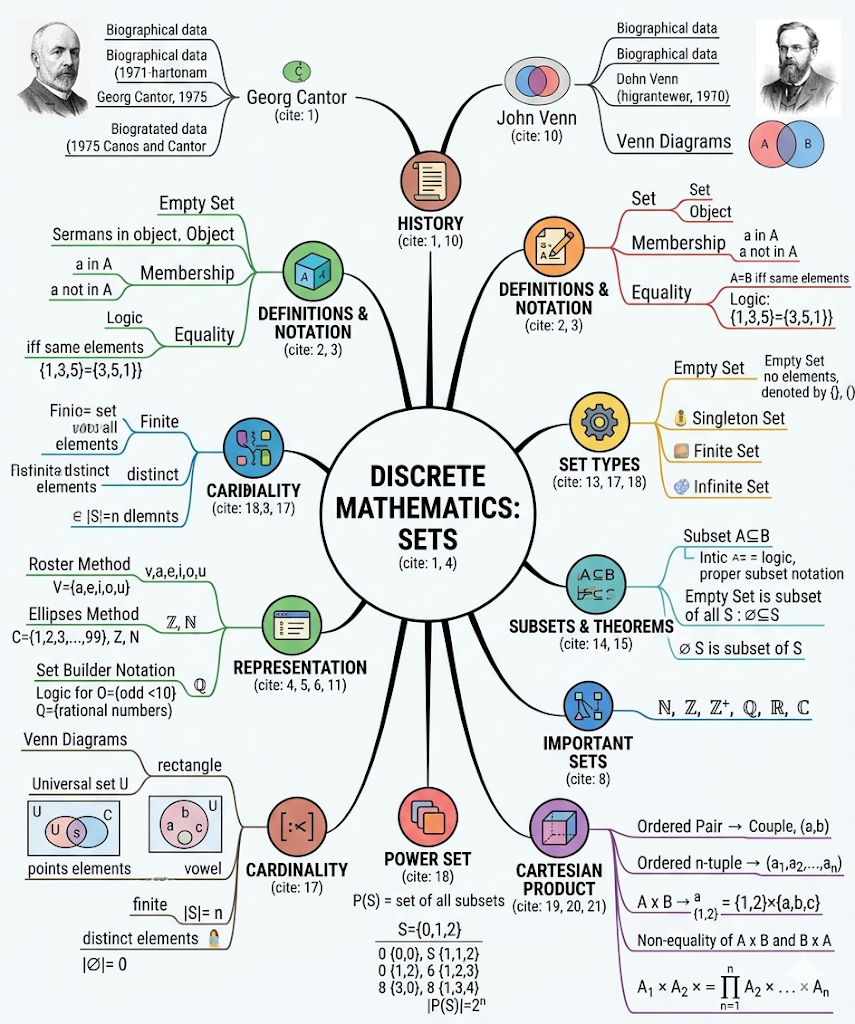
Here is your structured, comprehensive exam note for Set Operations based exactly on your slides. Uncommon or technical words are translated into Bangla (বাংলা) right next to them to maximize your last-minute revision efficiency.
Discrete Mathematics: Lecture Notes on Set Operations
1. Fundamental Set Operations (মৌলিক সেট প্রক্রিয়াসমূহ)
A. Union of Sets (সেটের সংযোগ)
-
Definition: The union of sets \(A\) and \(B\), denoted by
(চিহ্ন দ্বারা প্রকাশিত)\(A \cup B\), is the set that contains those elements that are either in \(A\) or in \(B\), or in both. -
Logical Form:
(Note: \(\vee\) represents the logical 'OR' operator)
B. Intersection of Sets (সেটের ছেদ)
-
Definition: The intersection of sets \(A\) and \(B\), denoted by \(A \cap B\), is the set containing those elements that are in both \(A\) and \(B\).
-
Logical Form:
(Note: \(\wedge\) represents the logical 'AND' operator)
C. Disjoint Sets (নিশ্ছেদ সেট)
-
Definition: Two sets are called disjoint if their intersection is the empty set
(ফাঁকা সেট). -
Mathematical Condition: \(A \cap B = \emptyset\).
D. Difference of Sets (সেটের অন্তর)
-
Definition: The difference of \(A\) and \(B\), denoted by \(A - B\), is the set containing those elements that are in \(A\) but not in \(B\).
-
Alternative Name: It is also called the complement
(পূরক)of \(B\) with respect to \(A\)(A এর সাপেক্ষে B এর পূরক). -
Logical Form:
E. Symmetric Difference of Sets (সেটের সুষম অন্তর)
-
Definition: The symmetric difference of \(A\) and \(B\), denoted by \(A \oplus B\), is the set containing those elements in either \(A\) or \(B\), but not in both \(A\) and \(B\).
-
Logical Form:
(Note: \(\oplus\) represents the logical 'Exclusive OR / XOR' operator)
F. Complement of Sets (সেটের পরম পূরক)
-
Definition: Let \(U\) be the universal set
(সার্বিক সেট). The complement of set \(A\), denoted by \(\overline{A}\) or \(A^c\), is the set containing those elements that are in \(U\) but not in \(A\). -
Key Property: It is essentially the complement of \(A\) with respect to \(U\), meaning \(U - A\).
-
Logical Form:
2. Principle of Inclusion-Exclusion (অন্তর্ভুক্তি-বর্জনের নীতি)
-
Core Concept: The number of elements in the union of two sets is equal to the number of elements in the first set plus
(যোগ)the number of elements in the second one, minus(বিয়োগ)the number of elements in their intersection. -
Reasoning: The intersection elements must be subtracted because they were counted twice
(দুইবার গণনা করা হয়েছিল)when adding \(|A|\) and \(|B|\). -
Theorem Formula:
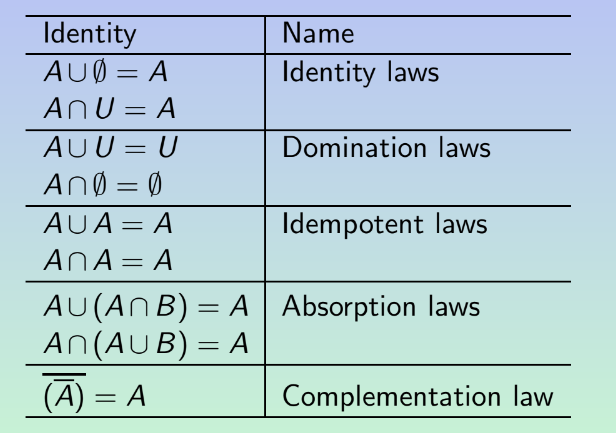
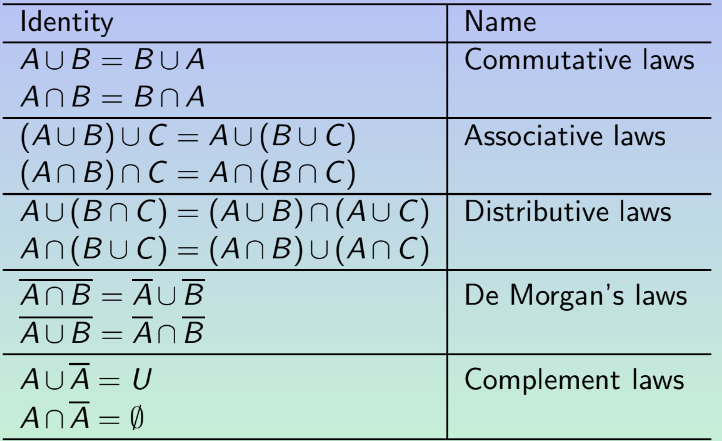
3. Set Identities (সেটের অভেদসমূহ / সূত্রাবলী)
You must memorize these laws and names perfectly for the exam:
4. Membership Table (সদস্যতা সারণী)
-
Purpose: Used to consider each combination
(সমাবেশ)of sets that an element can belong to and verify(প্রমাণ করা)that the set identity holds true. -
Rules:
-
Use 1 to indicate
(নির্দেশ করতে)that an element is in a set. -
Use 0 to indicate that an element is not in a set.
-
Example from Slides: Verifying De Morgan's Law \(\overline{A \cup B} = \overline{A} \cap \overline{B}\):
| \(A\) | \(B\) | \(A \cup B\) | \(\overline{A \cup B}\) | \(\overline{A}\) | \(\overline{B}\) | \(\overline{A} \cap \overline{B}\) |
|---|---|---|---|---|---|---|
| 1 | 1 | 1 | 0 | 0 | 0 | 0 |
| 1 | 0 | 1 | 0 | 0 | 1 | 0 |
| 0 | 1 | 1 | 0 | 1 | 0 | 0 |
| 0 | 0 | 0 | 1 | 1 | 1 | 1 |
(Since the columns for \(\overline{A \cup B}\) and \(\overline{A} \cap \overline{B}\) match identically, the law is verified.)
5. Generalized Operations (সাধারণীকৃত বা বহু-সেট প্রক্রিয়াকরণ)
A. Generalized Union of Sets (সাধারণীকৃত সংযোগ)
-
Definition: The union of a collection
(সংগ্রহ)of sets is the set that contains those elements that are members of at least one(কমপক্ষে একটি)set in the collection. -
Notation:
B. Generalized Intersection of Sets (সাধারণীকৃত ছেদ)
-
Definition: The intersection of a collection of sets is the set that contains those elements that are members of all the sets
(প্রত্যেকটি সেটের)in the collection. -
Notation: