CHE2122 - Chemistry
Atomic Structure and Periodicity
Term 161
- Q1(a) [4]: Describe the postulates of Bohr's theory of atom.
- Q1(b) [4]: What is ionization energies and electronegativity.
- Q1(c) [6]: Explain the periodicity of atomic volume and valency.
Term 171
- Q1(a) [3+5]: Define orbit and orbital. Are 2P, 3f and 4S² orbital possible? Explain your answer.
- Q1(b) [6]: What is the maximum number of electrons that can be present in the principal level for which n = 4?
- Q5(c) [5]: Show the hydrogen bonding in acetic acid molecules and find Isotope, Isobar, Isotone from the following atoms: \({}^{12}_{6}C\), \({}^{14}_{6}C\), \({}^{28}_{14}Si\), \({}^{27}_{13}Al\) and \({}^{13}_{6}C\).
- Q7(a) [8]: Write short notes on the followings: (i) Noble gasses; (ii) Hydrogen bonding; (iii) Normality and pH of solutions; (iv) Diamagnetism and paramagnetism.
Term 181
- Q1(a) [3]: What is an orbital?
- Q1(b) [3]: Write down the rules of ground state electron configuration of elements.
- Q1(c) [3]: Write the name of the orbital for which the quantum numbers are \(n=2\) and \(l=1\).
- Q1(d) [5]: Write the ground state electron configuration of element Na.
- Q3(a) [2+4]: What is ionization energy? Explain "ionization energy increases across a period".
- Q3(b) [2+2]: What are Nobel gases? What are their properties?
- Q5(a) [2+3]: What are isotopes and isobars? Choose isotopes and isobars from the following list.
- Q7(c) [4]: Why does the electron affinity decrease down a group except fluorine?
Term 201
- Q1(a) [4]: Describe Rutherford's atomic model and mention its weakness.
- Q1(b) [4]: Write down postulates of Bohr's theory.
- Q1(c) [6]: Find out the number of orbitals for which the following sets of quantum numbers is possible \(n=3\), \(l=2\) and \(m=(+2)\).
- Q2(a) [5]: Write down the ground state electron configuration of following elements: (i) C(6); (ii) S(16); (iii) Mo(42); (iv) Ni(28); (v) Na(11).
- Q2(b) [6]: Explain "electron affinity of an element decreases down a group". Why is the value of electron affinity for fluorine out of line?
- Q2(c) [3]: Why does the ionization energy of Na is lower than Li?
Term 211
- Q1(a) [5]: Define isotope and isobar with example.
- Q1(b) [2+2]: What is an orbital? Define Hund's rule.
- Q1(c) [5]: Mention the significance of quantum numbers.
- Q2(a) [5]: Write down the ground state electron configuration of the following elements: (i) C(6); (ii) S(16); (iii) Mo(42); (iv) Ni(28); (v) Na(11).
- Q2(b) [2+4]: What is ionization energy? Why does the ionization energy decrease down a group in the periodic table?
- Q2(c) [3]: Why is the electron affinity of Be negative?
Chemical Bonding and Molecular Structure
Term 161
- Q3(a) [9]: What is co-ordinate bond? Write the electronic formulae of the following compounds: (i) CO; (ii) H₂O₂; (iii) BF₃; (iv) C₂H₂.
- Q3(b) [5]: Explain the following: (i) Ice floats on water; (ii) Water exists as a liquid under the ordinary conditions while H₂S exists as gas under the same conditions.
Term 171
- Q5(c) [5]: Show the hydrogen bonding in acetic acid molecules.
- Q7(a) [8]: Write short notes on Noble gasses, Hydrogen bonding, Normality and pH of solutions, Diamagnetism and paramagnetism.
Term 181
- Q3(c) [6]: Write the electronic formulae of the following compounds: (i) C₂H₆; (ii) BF₃; (iii) PCl₅; (iv) H₂O₂.
- Q4(a) [4]: Define valance band, conduction band and forbidden band?
- Q4(b) [4]: How many types of overlapping of covalent bond are seen?
- Q4(c) [6]: Draw and explain the molecular orbitals of N₂ and O₂ according to MOT.
Term 201
- Q3(b) [5]: Draw and explain the molecular orbitals of O₂ according to MOT.
- Q3(c) [6]: Write the Lewis structure of the following molecules: (i) H₂O; (ii) NH₃; (iii) C₂H₂; (iv) BeCl₂; (v) CO₂; (vi) HF.
- Q4(a) [4]: Compare the properties of ionic and covalent compounds.
- Q4(b) [3x2]: Explain the following terms: (i) Hydrogen bonding; (ii) Metallic bonding; (iii) Water has maximum density at 4°C.
Term 211
- Q3(a) [4]: How many types of overlapping of covalent bonds are seen?
- Q3(b) [2+3]: Define co-ordination covalent bond. Show every type of bond available in NH₄Cl.
- Q3(c) [5]: Draw and explain the molecular orbitals of O₂ according to MOT.
Defects in Solids and Semiconductors
Term 161
- Q2(a) [4]: What are the conductors, insulators and semiconductors?
- Q2(b) [10]: Explain n-type and p-type semiconductors.
Term 171
- Q2(a) [2+6]: What are semiconductors? How does semiconductivity arise?
- Q2(b) [6]: What do you mean by valance band, conduction band and forbidden band?
- Q5(a) [2+2]: What are defects in solid/crystal? Write some importance of crystal defects.
- Q5(b) [3+3]: How many types of imperfections in crystalline solids? Give their names and explain point defects with suitable example.
Term 201
- Q3(a) [4]: What are semiconductors? What types of defects are present in stoichiometric compounds?
Term 211
- Q6(b) [2+2]: What are conductor and semiconductor?
- Q6(c) [2+3]: How many types of defects are available in solid? Explain point defect with suitable example.
Selective Organic Reactions
Term 161
- Q5(a) [6]: Define carbonyl compound. How does acetaldehyde react with the following reagents? (i) CH₃MgI; (ii) C₆H₅NHNH₂.
- Q5(b) [8]: Write a note on (i) Aldol condensation; (ii) Cannizzaro reaction; (iii) Nitration reaction; (iv) Friedel-Craft Alkylation.
Term 171
- Q6(a) [2+4]: Define carbonyl compounds. How can you chemically distinguish between aldehyde and ketones?
- Q6(b) [8]: Explain the following terms: (i) Markovnikov rule; (ii) Aldol condensation reaction; (iii) Halogenations reaction.
Term 181
- Q7(a) [4]: What are alcohol and aldehyde compounds?
- Q7(b) [6]: Write down the following organic reaction: (i) aldol reaction; (ii) cannizzaro reaction; (iii) haloform reaction; (iv) Nitration reaction.
Term 201
- Q7(a) [3]: What are alcohol and aldehyde compounds?
- Q7(b) [6]: Write down the following organic reactions: Aldol reaction, Cannizzaro reaction and Grignard reaction.
- Q7(c) [3]: How can you convert primary amide to primary amine?
Term 211
- Q7(a) [4]: What are the IUPAC names of the following compounds:
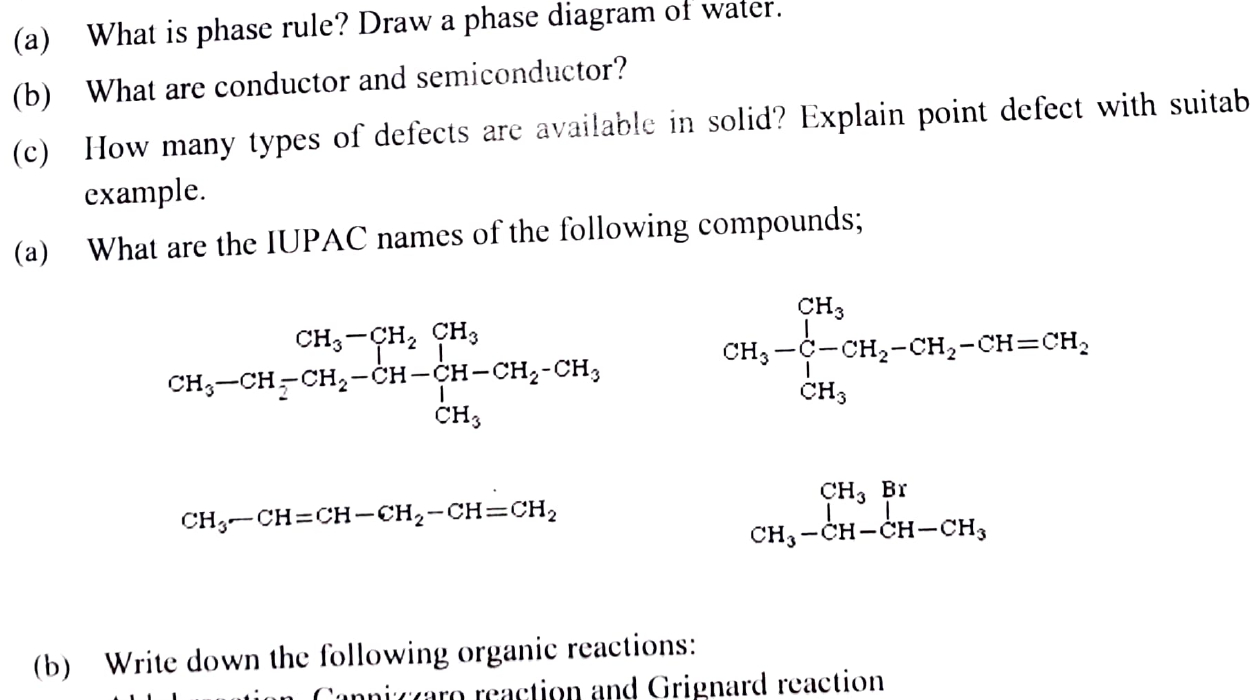
- Q7(b) [6]: Write down the following organic reactions: Aldol reaction, Cannizzaro reaction and Grignard reaction.
Solutions and Phase Rule
Term 161
- Q6(b) [6]: Explain the following terms: (i) Normality; (ii) Molarity; (iii) pH of Solutions.
- Q6(c) [4]: Calculate the molality of a sulfuric acid solution containing 24.4g of sulfuric acid in 198g of water. The molar mass of sulfuric acid is 98.08.
Term 171
- Q7(a) [8]: Write short notes on Normality and pH of solutions.
- Q7(b) [6]: Show how the pH scale was established from ionic product of water.
Term 181
- Q6(a) [4]: Explain the terms: (i) Normality; (ii) Molarity and (iii) Molality of a solution.
- Q6(b) [6]: Calculate the normality and molarity of a solution containing 20.7g of K₂CO₃ dissolved in 500ml of the given solution.
- Q6(c) [1+3]: What is meant by pH? Calculate the pH of 0.001N HCl assuming complete ionization of HCl.
Term 201
- Q4(c) [4]: Draw the phase diagram of the water system and find the degrees of freedom in every region of this diagram.
- Q6(b) [4]: State and derive the Raoult's law for dilute solution.
- Q6(c) [4]: 5.3 g of Na₂CO₃ is dissolved in 1 Kg of water. If the density of the solution is 0.997gmL⁻¹, calculate the molarity and normality of the solution.
- Q7(d) [2]: If a solution has a pH of 5.50 at 25°C, calculate its \([OH^-]\).
Term 211
- Q4(b) [2+2]: What are colligative properties? Why are they called colligative properties?
- Q4(c) [1+5]: What is the pH? Show that \(pK_w=pH+pOH\).
- Q6(a) [2+3]: What is phase rule? Draw a phase diagram of water.
Thermochemistry and Chemical Kinetics
Term 161
- Q4(a) [6]: Define order of a reaction, molecularity of a reaction and half life period.
- Q4(b) [5]: Show that for first order reactions the half life period is independent of the initial concentration.
- Q4(c) [3]: The half-life of a substance in a first order reaction is 20 minutes. Calculate the rate constant.
- Q6(a) [4]: What are exothermic and endothermic reactions?
Term 171
- Q3(a) [4]: Define order and molecularity of a reaction.
- Q3(b) [6]: Derive the rate equation for first order reaction.
- Q3(c) [4]: The rate constant for a first order reaction is \(1.54\times10^{-3}\,s^{-1}\). Calculate its half-life period.
- Q4(c) [4]: State the laws of thermochemistry.
Term 181
- Q2(a) [3]: What is the rate of reaction?
- Q2(b) [4+3]: Describe the equation to calculate the rate constant of a 1st order reaction and show the half-life of a 1st order reaction is independent of initial concentration of reactants.
- Q2(c) [4]: Compound A decomposes to form B and C, the reaction is 1st order. At 25°C the rate constant for the reaction is \(0.45s^{-1}\). What is the half-life of A at 25°C?
Term 201
- Q6(a) [6]: Derive mathematical expression for the rate constant of a reaction (A -> Products) of the first order.
Term 211
- Q7(c) [4]: Write the laws of thermochemistry.
Chemical Equilibria, pH, and Electrical Properties
Term 161
- Q7(a) [5]: What is reversible reactions and equilibrium constant?
- Q7(b) [5]: Establish a relationship between \(K_p\) and \(K_c\).
- Q7(c) [4]: Write a short note on "Le Chatelier's Principle".
Term 171
- Q4(a) [5]: Why chemical equilibrium is called a dynamic equilibrium?
- Q4(b) [5]: Derive the equilibrium constant (\(K_c\)) expression for the Schematic reaction \(mM+nN=xX+yY\).
Term 181
- Q5(b) [2+3]: What is equilibrium law? Establish the relation between \(K_p\) and \(K_c\).
- Q5(c) [4]: The value of \(K_p\) at 20°C for the reaction \(2NO(g)+Cl_2(g)\rightleftharpoons2NOCl(g)\) is \(1.9\times10^{-3}\,atm^{-1}\). Calculate the value of \(K_c\) at the same temperature.
Term 201
- Q5(a) [5]: What is equilibrium constant? Write down the characteristics of chemical equilibrium.
- Q5(b) [4]: Show the relation between \(K_c\) and \(K_p\).
- Q5(c) [5]: Calculate the concentration of \(OH^-\) ions from water at 298K in 0.02M HCl solution.
Term 211
- Q4(a) [4]: State the law of mass action.
- Q5(a) [1+4]: What is an equilibrium constant? Write down the characteristics of chemical equilibrium.
- Q5(b) [4]: Show the relation between \(K_p\) and \(K_c\).
- Q5(c) [5]: Calculate the concentration of \(OH^-\) ions from water at 298K in 0.02M HCl solution.