Index
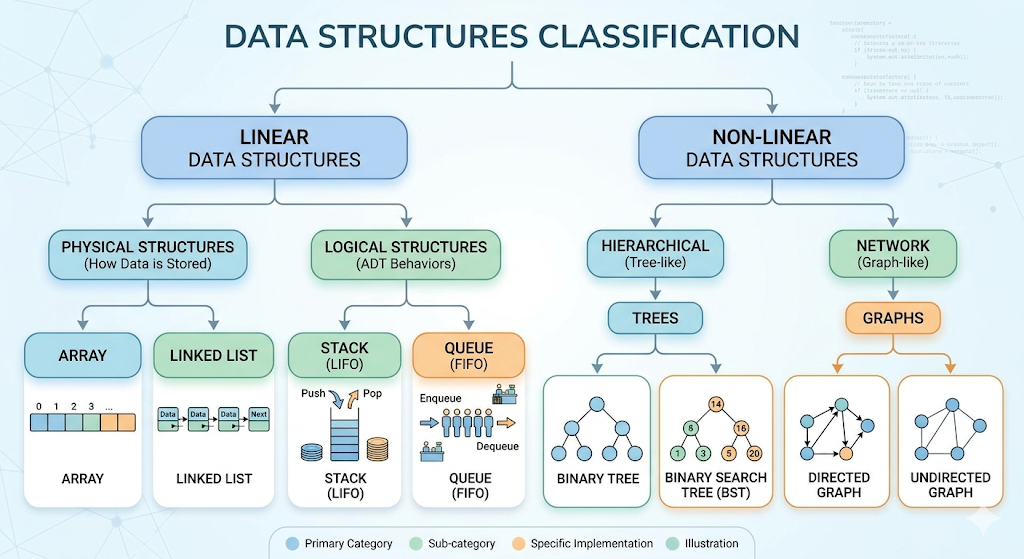
Omni-Classification of Data Structures:
Tier 1: The Building Blocks (Primitives)
These are the atomic units provided by the hardware/CPU. They don't "hold" other data; they are the data.
- Integer, Float, Char, Boolean.
- Pointers/References: (The "glue" used to build complex structures).
Tier 2: The Physical Containers (Implementation Layer)
These define how data is physically arranged in your RAM. Every complex structure in Tier 3 and 4 must be built using one of these.
| Structure | Memory Layout | Key Characteristic |
|---|---|---|
| Array | Contiguous | One solid block. Fast access via index, but hard to resize. |
| Linked List | Non-Contiguous | Scattered nodes connected by pointers. Easy to grow, slow to search. |
Tier 3: The Logical Rules (Linear ADTs)
These are Linear because the data follows a single sequence (one-after-another). They are just rules applied to Tier 2 containers.
- Stack (LIFO): Implementation:
Array-based StackorLinked-List Stack. - Queue (FIFO): Implementation:
Array-based QueueorLinked-List Queue. - List/Vector: A dynamic version of an array.
Tier 4: The Hierarchical & Relationship Models (Non-Linear ADTs)
These are Non-Linear because one element can connect to multiple other elements. They represent complex relationships.
A) Trees (Hierarchical)
Data is organized in a parent-child relationship.
- Binary Tree / BST: For fast searching.
- Heaps: For priority (Priority Queues).
- Tries: For dictionary/string searching.
- Note: Trees are usually implemented using Linked Nodes (Physical Tier 2).
B) Graphs (Network/Relational)
Data is organized as nodes (vertices) and connections (edges). No strict hierarchy.
- Directed/Undirected Graphs: Representing maps, social networks, or circuits.
- Implementation: Graphs are represented using an Adjacency Matrix (Physical Tier 2: 2D Array) or an Adjacency List (Physical Tier 2: Array of Linked Lists).
Tier 5: The "Abstracted" Collections (Specialized ADTs)
These are high-level concepts that often combine multiple tiers to solve specific problems.
- Hash Table / Dictionary: Uses an
Array+ aHash Functionto provide \(O(1)\) access. - Set: A collection of unique items (can be implemented via
Hash TableorTree).
The Big Picture Summary
| Category | Type | The "What" (Examples) | The "How" (Realization) |
|---|---|---|---|
| Linear | Physical | Array, Linked List | Direct Memory Mapping. |
| Linear | Logical (ADT) | Stack, Queue | Rules applied to Arrays/LL. |
| Non-Linear | Hierarchical | Tree, Heap | Parent-Child pointers. |
| Non-Linear | Relational | Graph | Network of nodes and edges. |
Why this solves your confusion:
When you see "Representing a Multi-dimensional Array (Tier 2/3) using a Linked List (Tier 2) as a Stack (Tier 3)," you are just moving between these tiers.
You are taking a Physical Container (Linked List), giving it the Behavioral Rules of a Stack, to store data that looks like a Matrix. It's like using Lego Bricks (Physical) to build a Garage (Logical Rule) for your Toy Cars (The Data).
Does this birds-eye view make the relationship between Trees, Arrays, and ADTs feel more organized?