Selective Organic Reactions
Term 161
- Q5(a) [6]: Define carbonyl compound. How does acetaldehyde react with the following reagents? (i) CH₃MgI; (ii) C₆H₅NHNH₂.
- Q5(b) [8]: Write a note on (i) Aldol condensation; (ii) Cannizzaro reaction; (iii) Nitration reaction; (iv) Friedel-Craft Alkylation.
Term 171
- Q6(a) [2+4]: Define carbonyl compounds. How can you chemically distinguish between aldehyde and ketones?
- Q6(b) [8]: Explain the following terms: (i) Markovnikov rule; (ii) Aldol condensation reaction; (iii) Halogenations reaction.
Term 181
- Q7(a) [4]: What are alcohol and aldehyde compounds?
- Q7(b) [6]: Write down the following organic reaction: (i) aldol reaction; (ii) cannizzaro reaction; (iii) haloform reaction; (iv) Nitration reaction.
Term 201
- Q7(a) [3]: What are alcohol and aldehyde compounds?
- Q7(b) [6]: Write down the following organic reactions: Aldol reaction, Cannizzaro reaction and Grignard reaction.
- Q7(c) [3]: How can you convert primary amide to primary amine?
Term 211
- Q7(a) [4]: What are the IUPAC names of the following compounds:
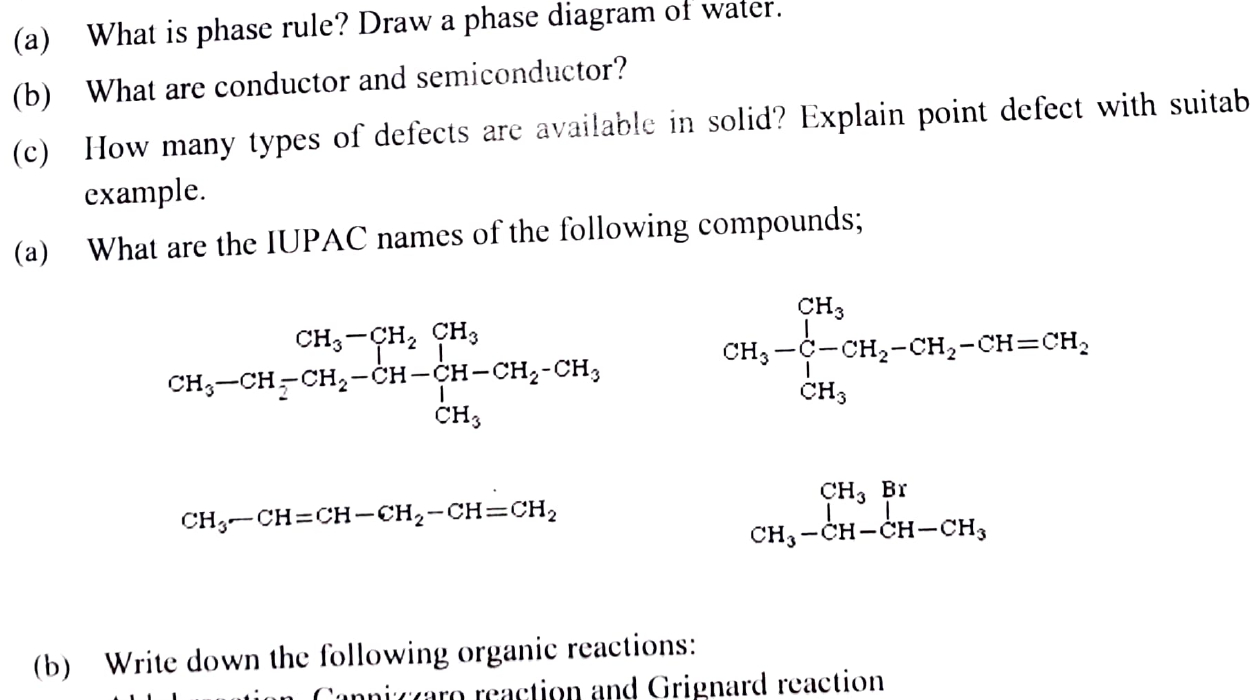
- Q7(b) [6]: Write down the following organic reactions: Aldol reaction, Cannizzaro reaction and Grignard reaction.