Revision
Vector Space and Vector Field
Vector Space and Vector Field
জুস দিয়ে সংজ্ঞা মনে রাখার ৩টি চাবিকাঠি:
- উপাদান (The Ingredients): জুসের ক্লাবে যেমন জুস থাকে, তেমনি ভেক্টর স্পেসে থাকবে ভেক্টরের একটি দল (Set of Vectors, \(V\)) এবং কিছু সংখ্যা (Set of Scalars, \(F\))।
- মেশানো (Mixing = Addition): দুইটা জুস মেশালে জুসই হয় \(\rightarrow\) দুইটা ভেক্টর যোগ করলে ভেক্টরই হতে হবে।
- পরিমাণ বাড়ানো/কমানো (Scaling = Multiplication): জুসকে পানি বা চিনি দিয়ে কম-বেশি করলে জুসই থাকে \(\rightarrow\) ভেক্টরকে সংখ্যা দিয়ে গুণ করলে ভেক্টরই হতে হবে।
এবার মনের ভেতর যেভাবে বাংলা থেকে ইংরেজি বানাবে (The Mental Translation):
পরীক্ষায় সংজ্ঞা চাইলে মনের ভেতর এই ৩টি লাইন সাজাবে:
- মনে মনে ভাববে: ভেক্টর স্পেস হলো একটা সেট \(V\), যার উপাদানগুলো হলো ভেক্টর।
- খাতায় লিখবে: A Vector Space is a set of elements (called vectors), denoted by \(V\), along with a set of numbers (called scalars), denoted by \(F\).
- মনে মনে ভাববে: এই সেটের ভেতর দুটি জিনিস মেনে চলতে হবে—যোগ এবং গুণ।
- খাতায় লিখবে: That satisfies two main operations: Vector Addition and Scalar Multiplication.
- মনে মনে ভাববে: যেকোনো দুটি ভেক্টর যোগ করলে বা স্কেলার দিয়ে গুণ করলে ফলাফলটা ওই সেট \(V\)-এর ভেতরেই থাকবে (জুস মিশালে জুসই হবে)।
- খাতায় লিখবে:
- For any two vectors \(u, v \in V\), their sum \(u + v\) must also be in \(V\) (Closure under addition).
- For any scalar \(c \in F\) and vector \(u \in V\), their product \(c \cdot u\) must also be in \(V\) (Closure under scalar multiplication).
শর্টকাট চিরকুট (যা পরীক্ষার আগে ১ সেকেন্ডে দেখবে):
Vector Space (\(V\)) = A set where (Vector + Vector = Vector) AND (Scalar \(\times\) Vector = Vector).
পরীক্ষায় প্রশ্ন আসলে শুধু জুসের এই "বাইরে যাওয়া যাবে না" (Closure Property) নিয়মটা মাথায় রাখবে। তাহলেই বানিয়ে লিখে আসতে পারবে যে, ভেক্টর স্পেস হলো এমন একটা সেট যেখানে যোগ এবং গুণ করলে ফলাফল সবসময় ওই সেটের ভেতরেই থাকে।
এই শর্টকাট টেকনিকটা কি সংজ্ঞা মনে রাখা সহজ করছে? নাকি পরীক্ষায় বানিয়ে লিখতে ইংরেজি বাক্য সাজাতে আরেকটু সাহায্য লাগবে?
Vector Field-কে জুসের ভাষায় মনে রাখার জন্য সবচেয়ে সহজ চাবিকাঠি হলো: "The GPS Map" (একটি ম্যাপ বা মানচিত্র)।
ভেক্টর স্পেস যেমন ছিল একটা দলের নিয়ম, ভেক্টর ফিল্ড হলো একটা জায়গার ম্যাপ।
🗺️ জুস ও ম্যাপ দিয়ে ভেক্টর ফিল্ড মনে রাখার ট্রিক:
মনে করো, তুমি একটা বড় জুস ফ্যাক্টরির ম্যাপ দেখছ। ফ্যাক্টরির মেঝেতে অনেকগুলো পয়েন্ট বা বিন্দু আছে।
- পাইপের ভেতর দিয়ে জুস কোন দিকে, কত স্পিডে যাচ্ছে—সেটা বোঝানোর জন্য মেঝের প্রতিটি বিন্দুতে একটা করে তীর চিহ্ন (Arrow) এঁকে দেওয়া হয়েছে।
- প্রবেশদ্বারের বিন্দুতে তীর চিহ্নটি ছোট এবং ডান দিকে (ধীর গতি)।
- মিক্সিং মেশিনের কাছের বিন্দুতে তীর চিহ্নটি বড় এবং গোল হয়ে ঘুরছে (তীব্র গতি ও ঘূর্ণন)।
এই যে পুরো মেঝে বা জায়গা জুড়ে প্রতিটি বিন্দুতে একটি করে তীর চিহ্ন (ভেক্টর) বসানো আছে, এই পুরো সিস্টেমটাই হলো একটা Vector Field।
📝 এবার পরীক্ষার জন্য মনের ভেতর যেভাবে Definition সাজাবে:
- মনে মনে ভাববে: ভেক্টর ফিল্ড হলো একটা নির্দিষ্ট জায়গা (Space/Domain), যার প্রতিটি পয়েন্টের সাথে একটা করে ভেক্টর জোড়া দেওয়া থাকে।
- খাতায় লিখবে: A Vector Field is a construction that assigns a vector to every point in a space (or domain).
- গাণিতিক রূপ (সহজ ভাষায়): এটি একটি ফাংশন, যা ইনপুট হিসেবে নেয় একটি পয়েন্ট \((x, y)\) এবং আউটপুট হিসেবে দেয় একটি ভেক্টর।
- খাতায় লিখবে: It is a function \(F\) that maps each point \((x, y)\) in \(\mathbb{R}^2\) to a vector \(F(x, y)\). [1, 2, 3, 4, 5]
⚡ এক নজরে দুইটার পার্থক্য (পরীক্ষার আগের শেষ রিভিশন):
| বৈশিষ্ট্য | Vector Space (ভেক্টর স্পেস) | Vector Field (ভেক্টর ফিল্ড) |
|---|---|---|
| মূল কনসেপ্ট | A Club/Rules (একটি দল ও তার নিয়ম) | A Map (একটি জায়গা বা অঞ্চল) |
| কী থাকে? | শুধু ভেক্টরদের একটা মেম্বারশিপ তালিকা। | একটি স্পেস, যেখানে প্রতিটা কোণায় ভেক্টর বসানো আছে। |
| জুস দিয়ে মনে রাখুন | জুস + জুস = জুস (নিয়ম)। | পাইপের কোন বিন্দুতে জুস কোন দিকে কত বেগে যাচ্ছে (ম্যাপ)। |
| বাস্তব উদাহরণ | গ্রাফ পেপারের সব বিন্দুর সেট। | বাতাসের বেগ, মহাকর্ষ বল বা নদীর স্রোতের ম্যাপ। |
ভেক্টর ফিল্ডের এই "ম্যাপ" বা "পয়েন্টে পয়েন্টে ভেক্টর" থাকার আইডিয়াটা কি পুরোপুরি মাথায় ঢুকেছে?
All other Definitions
All other Definitions
চ্যাপ্টার ১ ও ২: ভেক্টরের বেসিক ডেফিনিশনস## ১. Unit Vector (একক ভেক্টর)
- 🧠 ট্রিক: জায়ান্ট রোবটকে ইনজেকশন দিয়ে ঠিক ১ ফুট সাইজের বানিয়ে ফেলা (The Mini-Me)।
- 📝 Bookish Definition:
A vector having a magnitude of unity (one) is called a unit vector. If \(\vec{A}\) is a non-zero vector, then the unit vector \(\hat{u}\) in the direction of \(\vec{A}\) is defined as:
$\(\hat{u} = \frac{\vec{A}}{\vert{}\vec{A}\vert{}}\)$
২. Position Vector (অবস্থান ভেক্টর)
- 🧠 ট্রিক: জিরো পয়েন্ট থেকে তোমার বন্ধুর লোকেশনের দিকে সোজা গুগল ম্যাপের পিন (📍)।
- 📝 Bookish Definition:
A vector that represents the position of a point in space relative to a fixed origin \(O(0,0,0)\) is called a position vector. For a point \(P(x, y, z)\), it is given by:
$\(\vec{r} = x\hat{i} + y\hat{j} + z\hat{k}\)$
৩. Scalar Field (স্কেলার ফিল্ড)
- 🧠 ট্রিক: গরম চায়ের কাপের বিভিন্ন বিন্দুর তাপমাত্রা (শুধু মান আছে, দিক নাই ☕)।
- 📝 Bookish Definition:
If to each point \((x, y, z)\) of a region in space there corresponds a scalar number \(\phi(x, y, z)\), then \(\phi\) is called a scalar field.
Example: \(\phi(x, y, z) = 3x^2z - xy^3 + 5\).
৪. Vector Field (ভেক্টর ফিল্ড)
- 🧠 ট্রিক: ঝড়ের ম্যাপ, যেখানে প্রতিটা শহরে বাতাসের নির্দিষ্ট গতি ও দিক দুই-ই আছে (🌪️)।
- 📝 Bookish Definition:
If to each point \((x, y, z)\) of a region in space there corresponds a vector \(\vec{F}(x, y, z)\), then \(\vec{F}\) is called a vector field.
Example: Wind velocity or gravitational force in space.
৫. Dot Product / Scalar Product (ডট গুণন)
- 🧠 ট্রিক: একই লাইনে গাড়ি ধাক্কা দেওয়া (Helper Rule)। গুণফল হবে একটি সাধারণ সংখ্যা।
- 📝 Bookish Definition:
The dot product of two vectors \(\vec{A}\) and \(\vec{B}\) is a scalar quantity defined as the product of the magnitudes of \(\vec{A}\) and \(\vec{B}\) and the cosine of the angle \(\theta\) between them.
$\(\vec{A} \cdot \vec{B} = \vert{}\vec{A}\vert{}\vert{}\vec{B}\vert{}\cos\theta\)$
৬. Cross Product / Vector Product (ক্রস গুণন)
- 🧠 ট্রিক: হেলিকপ্টারের পাখা ঘোরে ডানে-বামে, কিন্তু হেলিকপ্টার ওড়ে সোজা উপরে (লম্বালম্বি নতুন দিক)।
- 📝 Bookish Definition:
The cross product of two vectors \(\vec{A}\) and \(\vec{B}\) is a vector quantity whose magnitude is the product of their magnitudes and the sine of the angle \(\theta\) between them, and whose direction is perpendicular to the plane containing \(\vec{A}\) and \(\vec{B}\).
$\(\vec{A} \times \vec{B} = (\vert{}\vec{A}\vert{}\vert{}\vec{B}\vert{}\sin\theta)\hat{\eta}\)$
(Where \(\hat{\eta}\) is a unit vector perpendicular to the plane of \(\vec{A}\) and \(\vec{B}\).)
চ্যাপ্টার ৬: ইন্টিগ্রাল থিওরেমসমূহ (Dimension Shifting)## ৭. Gauss's Divergence Theorem (গাউসের ডাইভারজেন্স থিওরেম)
- 🧠 ট্রিক: বেলুনের ২D চামড়া দিয়ে বাতাস বের হওয়া = বেলুনের ৩D ভেতরের ভলিউমে বাতাস ঢোকা (🎈)।
- 📝 Bookish Definition:
Let \(V\) be the volume bounded by a closed surface \(S\) and \(\vec{F}\) be a continuously differentiable vector field. Then the divergence theorem states that the surface integral of \(\vec{F}\) over \(S\) is equal to the volume integral of the divergence of \(\vec{F}\) over \(V\):
$\(\iint_S \vec{F} \cdot \hat{n} \, dS = \iiint_V (\nabla \cdot \vec{F}) \, dV\)$
৮. Stoke's Theorem (স্টোকসের থিওরেম)
- 🧠 ট্রিক: বাগানের ১D সীমানা বা বেড়া ধরে হাঁটা = বাগানের ২D মেঝের ওপর বাতাসের ঘূর্ণন (Curl) মাপা (🏡)।
- 📝 Bookish Definition:
Let \(S\) be an open surface bounded by a closed curve \(C\), and \(\vec{F}\) be a continuously differentiable vector field. Then Stoke's theorem states that the line integral of \(\vec{F}\) around \(C\) is equal to the surface integral of the curl of \(\vec{F}\) over \(S\):
$\(\oint_C \vec{F} \cdot d\vec{r} = \iint_S (\nabla \times \vec{F}) \cdot \hat{n} \, dS\)$
৯. Green's Theorem in the Plane (সমতলে গ্রিনের থিওরেম)
- 🧠 ট্রিক: স্টোকসের থিওরেমটাই যখন থ্রি-ডি দুনিয়া ছেড়ে খাতার পাতার মতো একদম ২D ফ্ল্যাট সমতলে কাজ করে।
- 📝 Bookish Definition:
If \(P(x,y)\) and \(Q(x,y)\) are continuous functions having continuous partial derivatives in a region \(R\) bounded by a closed curve \(C\) in the \(xy\)-plane, then Green's theorem states:
$\(\oint_C (P \, dx + Q \, dy) = \iint_R \left( \frac{\partial Q}{\partial x} - \frac{\partial P}{\partial y} \right) dx \, dy\)$

The given second-degree equation \(8x^2 + 4xy + 5y^2 - 24x - 24y = 0\) reduces to the standard form \(\frac{x'^2}{4} + \frac{y'^2}{9} = 1\), which represents an ellipse.
1. Identify Conic Type
Compare the given equation with the general second-degree equation \(ax^2 + 2hxy + by^2 + 2gx + 2fy + c = 0\):
- \(a = 8, \quad h = 2, \quad b = 5\)
- \(g = -12, \quad f = -12, \quad c = 0\)
Calculate the discriminant \(h^2 - ab\):
$\(h^2 - ab = 2^2 - (8)(5) = 4 - 40 = -36\)$
Since \(h^2 - ab < 0\), the conic is an ellipse. [1]
2. Find the Center
Differentiate the equation partially with respect to \(x\) and \(y\) to locate the center \((x_1, y_1)\):
$\(\frac{\partial F}{\partial x} = 16x + 4y - 24 = 0 \implies 4x + y = 6\)$
$\(\frac{\partial F}{\partial y} = 4x + 10y - 24 = 0 \implies 2x + 5y = 12\)$
Solving this linear system yields the center:
- \(x_1 = 1\)
- \(y_1 = 2\)
3. Shift the Origin
Shift the origin to the center \((1, 2)\) using \(x = X + 1\) and \(y = Y + 2\). The constant term transforms to \(c'\):
$\(c' = gx_1 + fy_1 + c = -12(1) - 12(2) + 0 = -36\)$
The intermediate equation without linear terms is:
$\(8X^2 + 4XY + 5Y^2 - 36 = 0 \implies 8X^2 + 4XY + 5Y^2 = 36\)$
4. Rotate the Axes
Eliminate the \(XY\) cross-product term by finding the eigenvalues (\(\lambda\)) of the characteristic matrix:
$\(\begin{vmatrix} a - \lambda & h \\ h & b - \lambda \end{vmatrix} = 0 \implies \begin{vmatrix} 8 - \lambda & 2 \\ 2 & 5 - \lambda \end{vmatrix} = 0\)$
$\(\lambda^2 - 13\lambda + 36 = 0 \implies (\lambda - 4)(\lambda - 9) = 0\)$
Thus, \(\lambda_1 = 4\) and \(\lambda_2 = 9\). The rotated equation becomes:
$\(\lambda_1 x'^2 + \lambda_2 y'^2 + c' = 0 \implies 4x'^2 + 9y'^2 = 36\)$
Divide through by \(36\) to obtain the final standard form:
$\(\frac{x'^2}{9} + \frac{y'^2}{4} = 1 \quad \text{or} \quad \frac{x'^2}{4} + \frac{y'^2}{9} = 1 \text{ (depending on axis ordering)}\)$
✅ Final Answer
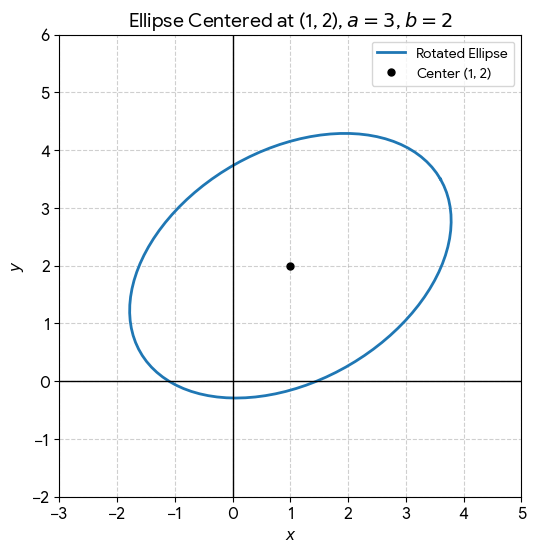
The standard form of the conic equation is \(\frac{x'^2}{4} + \frac{y'^2}{9} = 1\), which represents an ellipse with its center located at \((1, 2)\). [2]
If you would like to explore this further, let me know if you want to find:
- The eccentricity of this ellipse
- The coordinates of its foci or vertices
- The equations of its axes of symmetry
import numpy as np
Verify the matrix eigenvaluesA = np.array([[8, 2], [2, 5]])eigenvalues, eigenvectors = np.linalg.eigh(A)
print("Eigenvalues:", eigenvalues)
Verify center# 16x + 4y = 24# 4x + 10y = 24M = np.array([[16, 4], [4, 10]])B = np.array([24, 24])center = np.linalg.solve(M, B)
print("Center:", center)
Verify c'g, f, c = -12, -12, 0c_prime = g * center[0] + f * center[1] + c
print("c_prime:", c_prime)