Dynamic Scheduling
Lesson Context
Scheduling is one of the techniques used to improve the performance of a pipeline processor. The earlier lesson introduced scheduling and static scheduling. This lesson continues with dynamic scheduling.
The techniques discussed for improving pipeline-processor performance are:
- Instruction execution phases
- Mechanisms for instruction pipelining
- Dynamic instruction scheduling techniques
What Is Dynamic Scheduling?
Dynamic scheduling is a hardware-based approach.
In dynamic scheduling, the hardware rearranges the execution of instructions to reduce stalls while maintaining the data flow and exception behaviour.
Dynamic Scheduling: The hardware rearranges instruction execution to reduce stalls while maintaining data flow and exception behaviour.
flowchart TD
    A["Instructions"] --> B["Hardware rearranges instruction execution"]
    B --> C["Stalls are reduced"]
    C --> D["Data flow is maintained"]
    C --> E["Exception behaviour is maintained"]
Static Scheduling and Dynamic Scheduling
Static scheduling and dynamic scheduling use different approaches.
| Static Scheduling | Dynamic Scheduling |
|---|---|
| Software-based approach | Hardware-based approach |
| Compiler-based | Hardware-based |
| The compiler schedules or rearranges the instructions | The hardware rearranges instruction execution |
| Used when dependencies are known at compile time | Used when dependencies are not known at compile time |
In static scheduling, compiler techniques are used to schedule or rearrange instructions. The instruction is always scheduled by the compiler.
If dependencies between instructions are known at compile time, there is no need to use a hardware-based approach. The software itself modifies the instructions and minimizes the hazards.
If dependencies are not known at compile time, dynamic scheduling is used.
flowchart TD
    A["Dependencies between instructions"] --> B{"Known at compile time?"}
    B -->|Yes| C["Static Scheduling"]
    C --> D["Compiler rearranges instructions"]
    B -->|No| E["Dynamic Scheduling"]
    E --> F["Hardware rearranges instruction execution"]
Why Is Dynamic Scheduling Used?
Dynamic scheduling is used when the dependencies between instructions are not known at compile time.
The hardware itself rearranges instruction execution:
- To reduce stalls
- To maintain data flow
- To maintain exception behaviour
Dynamic scheduling also simplifies the compiler. This is why dynamic scheduling is preferred over static scheduling in this situation.
flowchart LR
    A["Unknown dependencies at compile time"] --> B["Dynamic Scheduling"]
    B --> C["Hardware rearrangement"]
    C --> D["Reduced stalls"]
    C --> E["Simplified compiler"]
Dynamic Scheduling Schemes
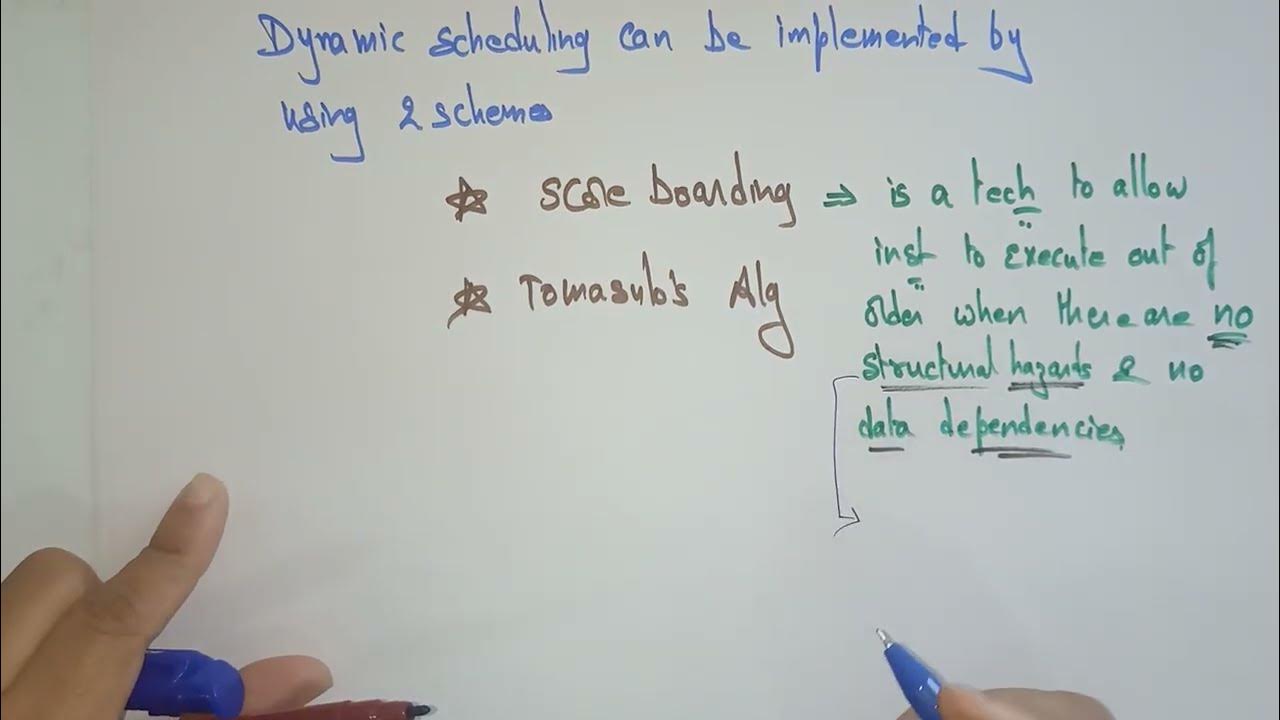
Dynamic scheduling can be implemented using two schemes:
- Scoreboarding
- Tomasulo’s Algorithm
flowchart TD
    A["Dynamic Scheduling"] --> B["Scoreboarding"]
    A --> C["Tomasulo’s Algorithm"]
    B --> D["Allows out-of-order execution"]
C --> E["Hardware dependence-resolution scheme"]Scoreboarding
Scoreboarding is a technique that allows instructions to execute out of order when there are:
- No structural hazards
- No data dependencies
Scoreboarding: A technique that allows instructions to execute out of order when there are no structural hazards and no data dependencies.
No Structural Hazards
No structural hazards means that sufficient resources are available.
No Data Dependencies
No data dependencies means that there are no data hazards.
Therefore, scoreboarding permits out-of-order instruction execution when sufficient resources are available and no data hazards exist.
flowchart TD
    A["Scoreboarding"] --> B{"Sufficient resources?"}
    B -->|No| C["Structural hazard exists"]
    B -->|Yes| D{"No data hazards?"}
    D -->|No| E["Data dependency exists"]
    D -->|Yes| F["Instructions may execute out of order"]
Tomasulo’s Algorithm
Tomasulo’s Algorithm is a hardware dependence-resolution scheme.
Tomasulo’s Algorithm: A hardware dependence-resolution scheme used for dynamic scheduling.
The detailed explanation and example of Tomasulo’s Algorithm are continued in the next lesson. Scoreboarding and its example are also explained separately.
Complete Summary
- Dynamic scheduling is used to improve pipeline-processor performance.
- It is a hardware-based approach.
- Static scheduling is a software-based or compiler-based approach.
- Static scheduling is used when dependencies are known at compile time.
- Dynamic scheduling is used when dependencies are not known at compile time.
- In dynamic scheduling, hardware rearranges instruction execution.
- Hardware rearrangement reduces stalls.
- Data flow and exception behaviour are maintained.
- Dynamic scheduling simplifies the compiler.
- Dynamic scheduling can be implemented using Scoreboarding and Tomasulo’s Algorithm.
- Scoreboarding allows instructions to execute out of order when there are no structural hazards and no data dependencies.
- No structural hazards means sufficient resources are available.
- No data dependencies means there are no data hazards.
- Tomasulo’s Algorithm is a hardware dependence-resolution scheme.