Index
Detailed Syllabus
Syllabus Details
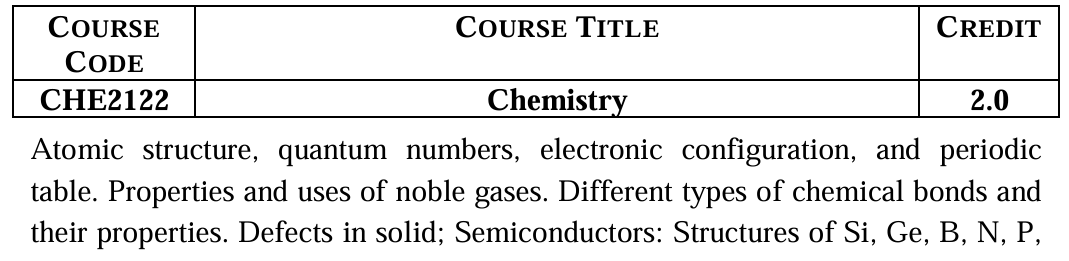
1. Atomic Structure and Periodicity
- Concept of atom and subatomic particles
- Atomic models: Thomson, Rutherford, and Bohr models
- Dual nature of matter and radiation
- Heisenberg uncertainty principle
- Quantum mechanical model of atom
- Atomic orbitals, shapes, and orientations
- Quantum numbers: principal, azimuthal, magnetic, and spin
- Electronic configuration of elements
- Aufbau principle, Pauli exclusion principle, Hund’s rule
- Periodic table: long form periodic table
- Periodic properties: atomic radius, ionic radius, ionization energy, electron affinity, electronegativity
- Variation of properties across periods and groups
2. Noble Gases
- Position of noble gases in the periodic table
- Electronic configuration of noble gases
- General properties: physical and chemical properties
- Reasons for inertness
- Compounds of noble gases (especially xenon compounds)
- Uses of noble gases in industry, medicine, lighting, and research
3. Chemical Bonding
- Cause of chemical bonding
-
Types of chemical bonds
-
Ionic bond
- Covalent bond
- Coordinate covalent bond
- Metallic bond
- Hydrogen bond
- Bond parameters: bond length, bond angle, bond energy
- Polarity of bonds and molecules
- Valence bond theory
- Hybridization and molecular geometry
- Molecular orbital theory
- Bonding in homonuclear and heteronuclear molecules
- Theory of resonance and resonating structures
4. Solid State and Defects in Solids
- Classification of solids: crystalline and amorphous
- Types of crystal lattices
- Unit cell and packing efficiency
-
Imperfections in solids
-
Point defects
- Schottky defect
- Frenkel defect
- Non-stoichiometric defects
- Effect of defects on physical properties
5. Semiconductors
- Classification of solids based on conductivity
- Conductors, semiconductors, and insulators
- Intrinsic and extrinsic semiconductors
- n-type and p-type semiconductors
- Doping and its effect
- Crystal structure of silicon (Si), germanium (Ge), boron (B), nitrogen (N), phosphorus (P)
- Applications of semiconductors
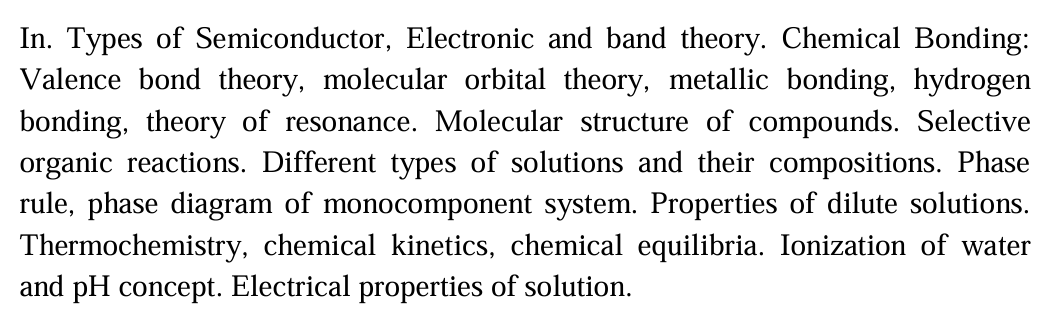
6. Electronic and Band Theory
- Energy bands in solids
- Valence band and conduction band
- Band gap concept
- Band theory of conductors, semiconductors, and insulators
- Effect of temperature on conductivity
7. Molecular Structure of Compounds
- Lewis structures
- VSEPR theory
- Shapes of simple molecules
- Hybridization and molecular geometry
- Polarity and dipole moment
8. Selective Organic Reactions
-
Classification of organic reactions
-
Addition reactions
- Substitution reactions
- Elimination reactions
- Rearrangement reactions
- Basic reaction mechanisms
- Simple examples of industrial and biological importance
9. Solutions
- Types of solutions based on physical states
- Solubility and factors affecting solubility
- Concentration terms: molarity, molality, normality, mole fraction
- Ideal and non-ideal solutions
10. Phase Rule and Phase Diagrams
- Gibbs phase rule
- Phase diagram of one-component (monocomponent) system
- Phase diagram of water
- Triple point and critical point
- Applications of phase rule
11. Properties of Dilute Solutions
-
Colligative properties
-
Relative lowering of vapor pressure
- Elevation of boiling point
- Depression of freezing point
- Osmotic pressure
- Abnormal molecular mass and van’t Hoff factor
12. Thermochemistry
- System and surroundings
- Types of thermodynamic systems
- Laws of thermodynamics (basic idea)
- Enthalpy changes
- Hess’s law
- Bond energy and calorimetry
13. Chemical Kinetics
- Rate of chemical reaction
- Factors affecting reaction rate
- Rate law and order of reaction
- Molecularity
- Activation energy
- Arrhenius equation
14. Chemical Equilibrium
- Reversible and irreversible reactions
- Law of mass action
- Equilibrium constant
- Factors affecting equilibrium (Le Chatelier’s principle)
15. Ionization of Water and pH Concept
- Self-ionization of water
- Ionic product of water (Kw)
- pH and pOH scale
- Acids, bases, and salts
- Strong and weak acids and bases
- Buffer solutions and their importance
16. Electrical Properties of Solutions
- Electrolytes and non-electrolytes
- Strong and weak electrolytes
- Conductance of solutions
- Specific conductance and equivalent conductance
- Kohlrausch’s law
- Applications of conductance measurements