Operators and Expressions
x = x + 1; and x++;
Ans to the Question
Introduction
In C programming, both x = x + 1; and x++; are used to increase the value of a variable (চলক) by 1. However, when it comes to efficiency and programming style, there is a subtle difference between the two.
Statement:
Between the two statements, x++; is considered more efficient and is preferred by programmers.
Below is the detailed explanation of why this is the case.
1. Theoretical Efficiency (Machine Level)
To understand the efficiency, we must look at how these high-level instructions are converted into Machine Code or Assembly Language by the Compiler (কম্পাইলার).
**Case A: x = x + 1;**
This is a standard arithmetic expression. Theoretically, the computer performs this in three steps:
- Load: It loads the value of
xfrom memory into a CPU Register (রেজিস্টার). - Add: It adds the constant value
1to that register. -
Store: It stores the new value back into the memory location of
x. -
Instruction:
ADD x, 1(Requires fetching the variable and the constant).
**Case B: x++;**
This uses the Increment Operator. Most processors have a specific machine instruction designed solely to increment a value by 1.
- Instruction:
INC x(Single machine instruction).
Conclusion on Machine Cycles:
Historically, the INC instruction executes faster and takes fewer CPU cycles (সিপিইউ সাইকেল) than the general ADD instruction. Therefore, x++ is theoretically faster.
2. Compiler Optimization (Modern Context)
It is important to note that modern C compilers (like GCC or Clang) are extremely smart or Optimized (অপ্টিমাইজ করা).
- If optimization is enabled, the compiler realizes that
x = x + 1is doing the same work asx++. - Therefore, it generates the same machine code for both.
- So, in a modern computer, you might not see a measurable speed difference, but
x++remains the "native" way to increment in C.
3. Readability and Clarity
Efficiency is not just about execution speed; it is also about writing clean code.
- Conciseness:
x++is shorter and easier to type. - Clarity: It clearly signals the intent (উদ্দেশ্য) that "we are just stepping to the next value".
x = x + 1looks like a mathematical equation. - Address Calculation: In complex cases like
arr[i++], using the increment operator is significantly more efficient and readable than writingarr[i]; i = i + 1;.
Comparison Summary
| Feature | x = x + 1; |
x++; |
|---|---|---|
| Operator Type | Assignment + Arithmetic | Unary Increment Operator |
| Instruction | Typically ADD |
Typically INC |
| Execution | Might involve data movement. | Direct register operation. |
| Preferred Usage | Mathematical formulas. | Loops and counters. |
Conclusion
While modern compilers make them equal in speed, x++; is technically the efficient choice because it maps directly to the hardware's increment instruction. It is the standard idiom in C programming.
Difference between Pre-increment and Post-increment
Pre-increment vs Post-increment
Ans to the Question
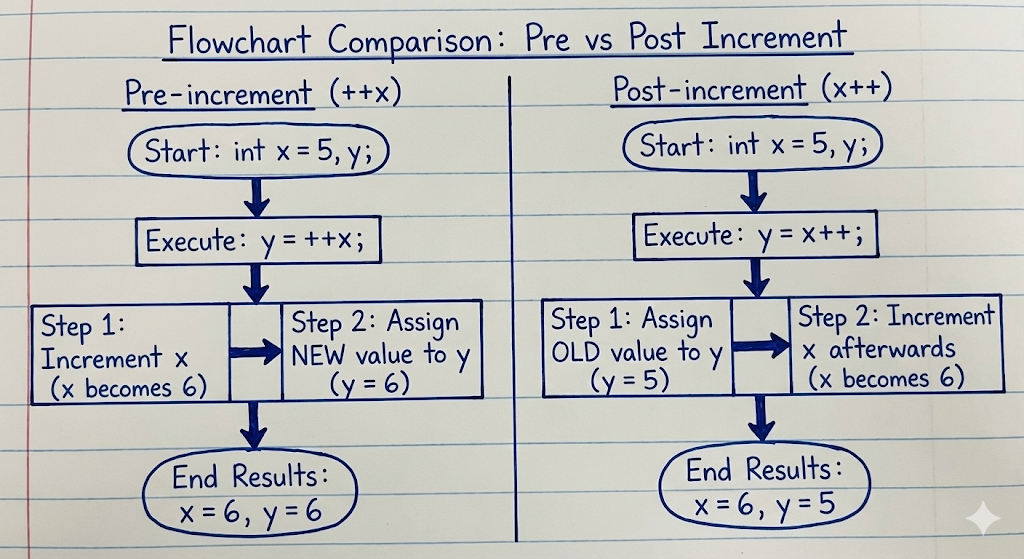
In C programming, the increment operator (++) is used to increase the value of a variable by 1. However, the position of the ++ sign determines when the increment happens. This distinction is very important when used inside an expression (রাশিমালা).
We classify them into two types:
- Pre-increment (
++x): Change then Use. - Post-increment (
x++): Use then Change.
1. Pre-increment Operator (++x)
In Pre-increment (প্রাক-বৃদ্ধি), the operator is written before the operand.
- Rule: "First increment, then use."
- How it works:
- First, the value of the variable is increased by 1 immediately.
- Then, the new (updated) value is used in the expression or assignment.
Example:
Result: a = 11, b = 11.
2. Post-increment Operator (x++)
In Post-increment (পর-বৃদ্ধি), the operator is written after the operand.
- Rule: "First use, then increment."
- How it works:
- First, the current (original) value of the variable is used in the expression or assignment.
- After that line is executed, the value of the variable is increased by 1.
Example:
Result: a = 11, b = 10.
Comparison Code Snippet
To clearly understand the difference, let us look at a single program illustrating both.
#include <stdio.h>

int main() {
int x = 5, y = 5;

// Case 1: Pre-increment
printf("Pre-increment: %d\n", ++x); // Prints 6 (Increments first)

// Case 2: Post-increment
printf("Post-increment: %d\n", y++); // Prints 5 (Prints first, then increments)

// Checking final values
printf("Final x: %d, Final y: %d", x, y); // Both are 6 now

return 0;
}
Summary Table
| Feature | Pre-increment (++i) |
Post-increment (i++) |
|---|---|---|
| Symbol Position | Before the variable. | After the variable. |
| Logic | Increment Assignment | Assignment Increment |
| Priority | Higher priority in execution order. | Value is updated after the current statement. |
| Memory Action | Updates memory immediately before fetch. | Fetches old value, then updates memory. |
Conclusion
If used alone (like x++; or ++x;), there is no difference in the result. But when used inside a formula or function (like y = x++), Pre-increment uses the new value, while Post-increment uses the old value.
Which is Faster: !#c ++x (Pre) or !#c x++ (Post)?
Ans to the Question
Which is Faster: ++x (Pre) or x++ (Post)?
Direct Answer:
Between the two, Pre-increment (++x) is technically faster and more efficient than Post-increment (x++).
Although modern Compilers (কম্পাইলার) optimize both to be nearly the same for simple variables (like int), theoretically and in complex scenarios, Pre-increment is the winner.
Why is Pre-increment (++x) Faster?
The main reason lies in the Number of Steps the computer has to perform internally to execute the instruction.
1. How Post-increment (x++) works:
When we write y = x++;, the computer has to do extra work to "remember" the old value.
- Step 1: Create a temporary copy (অস্থায়ী কপি) of
xto save its current value. - Step 2: Increment the real
x. - Step 3: Return the saved temporary copy.
- Step 4: Delete the temporary copy.
- Problem: The creation and deletion of the temporary copy takes extra time and memory.
2. How Pre-increment (++x) works:
When we write y = ++x;, it is very direct.
- Step 1: Increment
ximmediately. - Step 2: Return the new
x. - Benefit: No temporary copy is needed. It is a straight calculation.
Comparison of Steps
| Feature | Pre-increment (++x) |
Post-increment (x++) |
|---|---|---|
| Speed | Faster | Slightly Slower (due to overhead) |
| Memory | Uses less memory. | Uses extra memory for temporary storage. |
| Steps | Fetch Increment Use | Fetch Save Old Increment Use Old |
Conclusion
For simple counters in for loops (like int i), it does not make a visible difference today. However, it is a Good Programming Habit (ভাল অভ্যাস) to use ++x (Pre-increment) because it avoids unnecessary work for the machine.